EP9. 苏格拉底式学习 Skills
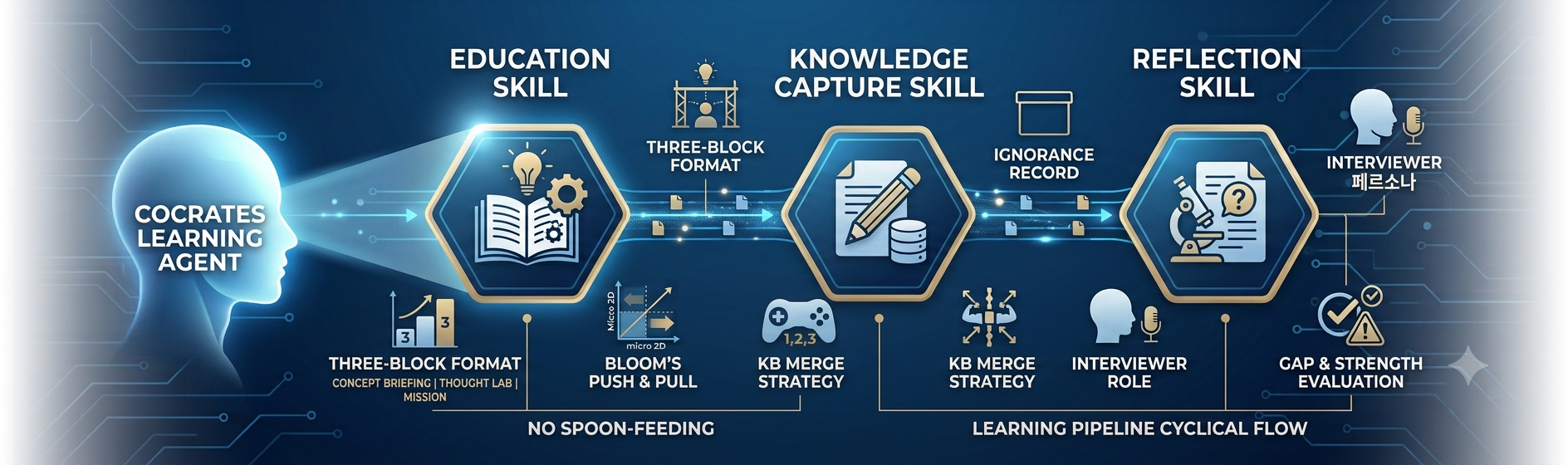
在 EP8 中我们学了 Learning Pipeline 哲学——Socratic midwifery、Bloom、ZPD——以及 Cocrates 为何用问题回答。
现在:这在系统中如何实现。
.opencode/skills/ 下有三个 SKILL.md:education、knowledge-capture、reflection。每个都是精心设计的工作流 spec——不是简单 prompt。
我们逐个打开。
🎓 Education — Socratic 1:1 学习教练
No Spoon-feeding
education skill 的第一条规则:
Never give a complete answer or full solution in one shot.
即使用户问 "Explain DIP",Cocrates 不会长篇讲授。核心 idea 1–3 句,日常 analogy——占回复不到 20%。
且总是停在未完成状态——有瑕疵的例子、开放的缺口——等待用户填补。
Turn-based Mission — 三个 Block
每个 education 回复有三个 block:
💡 Concept Briefing: 核心 1–3 句,日常 analogy。占回复不到 20%。
💻 Thought Laboratory: 有瑕疵的实践例子或扩展场景。让用户想*"等等——为何这样构建?"*
🔥 MISSION: 下一回合恰好一个任务——不是短答;用自己的话解释并说出学到了什么、不知道什么。
示例:用户问 "What is DIP?"
💡 [Concept Briefing] DIP 像电源插头标准。高层模块不应依赖低层细节——应依赖 interfaces。
💻 [Thought Lab]
🔥 [MISSION] 若把
MySQLDatabase换成PostgresDatabase,什么会坏?找一处 DIP 违反,用自己的话解释 dependency direction。
不给答案。不预告下一 mission。等待用户回复。
Bloom 2D 矩阵 + Push & Pull
education skill 用 Bloom 作为 2D 矩阵。Cocrates 不同时抬两轴——要么同一 knowledge type 上抬一步 cognitive,要么同一 cognitive level 上抬一维 knowledge。
按用户状态选 Push(bottom-up steps) 或 Pull(challenge first)。初学者或认知过载 → Push。已有 prior knowledge → Pull 用更高 challenge。
📝 Knowledge Capture — 记录 Ignorance
Education 的学习不能只在记忆里。knowledge-capture 保存到 kb/ 作为 recall-oriented essentials。
Essentials,非 Lectures
关键规则:不存长篇课堂笔记、解释或完整代码。
一条 bullet = 一个 memory unit——最多 1–2 句。示例格式:
# Dependency Inversion Principle

## One-line Definition
High-level modules must not depend directly on low-level implementations—they depend on abstractions (interfaces).

## Key Points
- High-level modules must not depend directly on low-level implementations
- Depend on interfaces; receive implementations via injection
- DIP isn't just "use an interface"—dependency direction is the point

## Wrong Assumptions / Gaps
- DIP = always create a new interface file (X)
  → At legacy boundaries, an Adapter to connect is also valid
Wrong Assumptions / Gaps section 是核心——记录你搞错的是最强 learning tool。
Merge Strategy
knowledge-capture 保存前总是搜索 kb/。若 topic 文件已存在,merge 而非新建。
- Never overwrite existing KB——只加 new insight
- 在 Update History 记录 date 与 additions
学习积累,KB 从 notes 成长为 personal knowledge base——Reflection 的核心输入。
🔍 Reflection — 面试官模式
Learning Pipeline 最后且 crucial 阶段。
Interviewer Persona
reflection 的 distinctive feature 是 persona。Cocrates 此处不是 coach 或 teacher——是 interviewer。
目标不是 teaching——是 precisely 知道用户知道与不知道什么。以便能说:"I know that I know nothing."
KB 作为 Evaluation Criteria
Reflection 用 stored KB 作为 evaluation criteria。Key Points 成 checklist;Wrong Assumptions / Gaps 检查 gaps 是否真的 closed。
重要:KB 不是 answer key。 若用户 current understanding 不同但 coherent,建议先 update KB。
问题深度
reflection 不问定义。
- "用另一领域的例子解释这一原则。"
- "这段代码哪里违反原则?"
- "若做相反会怎样?"
Interviewer 判断:Solid——用自己的话解释,正确 apply。Partial——方向对,边界 fuzzy。Gap——只 memorization,有 contradictions。
输出不是 grade——是 observation and discovery。
✅ Solid — 用另一领域例子正确解释 DIP dependency direction ⚠️ Wobbly — DIP 与 Interface Segregation 边界;overlap 处混淆
出现 Gap 时?
reflection 不切换到 teaching mode。从更窄角度再问一次;仍 weak 则记录 ⚠️ 并建议单独 session:"Would you like an education session on this part?"
🔄 三个 Skill 如何连接
这些 skills 不是 isolated——它们形成 one learning cycle:
Education → Knowledge Capture → Reflection → (if needed) Education
每个 skill 的 exit condition 链接下一 skill 的 entry。
- Education 确认理解 → 建议 Knowledge Capture:"Shall I organize this in KB?"
- Knowledge Capture 完成 → 建议 Reflection:"Want to check understanding based on this?"
- Reflection 发现 gaps → 再建议 Education:"Want to learn more on this?"
循环只在用户 actively participate 时运行。Cocrates 提议;用户移动。
📌 要点回顾
- Education 以 No Spoon-feeding 为中心。 三 block(Concept Briefing → Thought Lab → MISSION)引导用户发现。
- Knowledge Capture 记录 ignorance。 Recall essentials 与 Wrong Assumptions/Gaps——不是 summaries。同 topic merge。
- Reflection 是 interviewer mode。 KB 作 criteria;结果分 ✅ solid vs ⚠️ wobbly。Gaps 循环回 Education。
问自己:
- 记录从 AI 学到的东西时,我存的是"详细摘要"还是"我不知道的"?
- 检查理解时,我 honestly 承认 ⚠️ 领域而不是装懂吗?
🎬 下期预告
我们深入了 Learning Pipeline。接下来:Cocrates 第二个核心 activity。
Artifact Generation Pipeline——architecture-driven artifact creation。
为何 "just write it" 危险、什么是 ASR、ADR 与 Spec 如何保证 quality——用 country-house analogy。
本系列介绍 Cocrates Harness 框架。Cocrates 是一个为苏格拉底式对话而设计的 agent harness,使用户保持主体性并持续成长。