EP10. Architecture-Driven Generation Principles
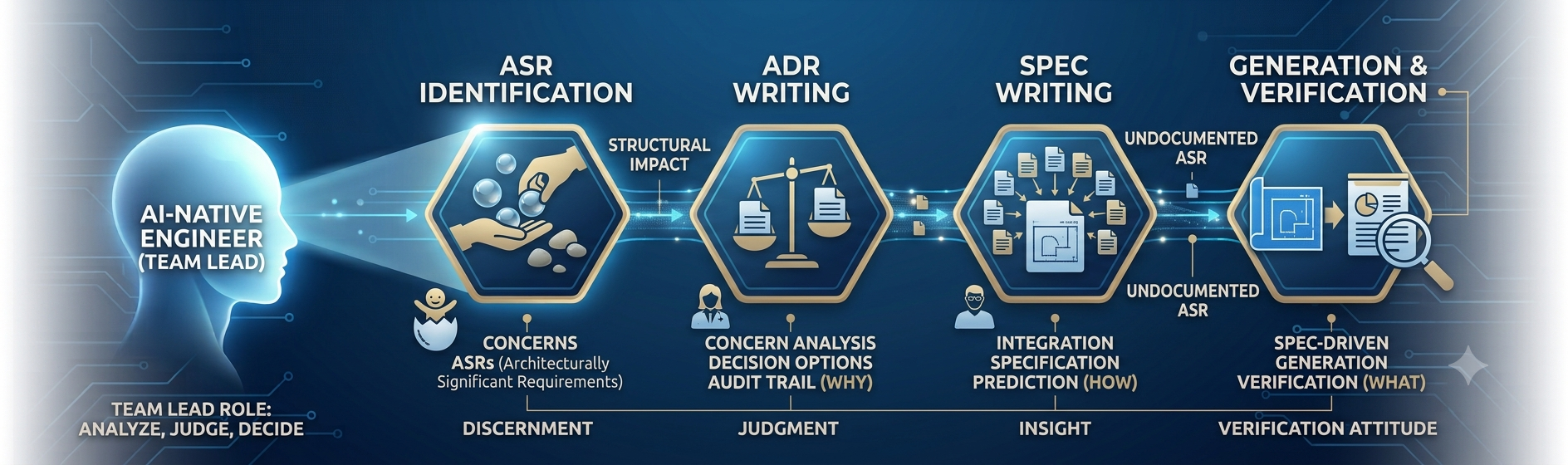
In Ep8 and Ep9 we explored Learning Pipeline philosophy and skills. Education → Knowledge Capture → Reflection—question, record ignorance, verify as interviewer.
Now Cocrates' second core activity: Artifact Generation Pipeline—architecture-driven artifact creation.
Remember: AI does the work. You are the AI-native engineer (team lead) who reviews and decides on what AI produces. In the age of AI doing everything for you, your value is how well you review, judge, and decide on AI's work.
If Learning was "how to recognize ignorance and grow knowledge," Generation is "how you review and approve AI's proposed structure, then build from that structure."
🚨 The Trap of "Just Write It"
You asked AI: "Write a report." Thirty pages in five seconds. You read it—thin logic, uneven depth per section. Hard to ask for a redo; you patch awkwardly and lose time.
What's the cause?
Generation without structure.
Unstructured output has three problems:
First, weak consistency and logic. No single thread—AI lists what sounds plausible moment to moment. Depth varies; claims don't align.
Second, you can't understand or explain the deliverable. "Looks fine" and move on—but "Why is this section structured this way?" stumps you. AI decided the structure, not you.
Third, an unreviewable black box. Review needs criteria. No structure? Only "does it look plausible?"
That's "just write it"—effectively "write it any which way."
🏗️ ASR — What Is the Fine China?
"Okay—I need to design structure first."
But "structure" is abstract—like "live well" without concrete steps.
Enter ASR (Architecturally Significant Requirement)—requirements or design decisions that materially affect structure, composition, and quality of the final deliverable. From software architecture, but applies to every deliverable type—documents, slides, blog series.
ASR matters because without reviewing ASR, AI fills gaps with Silent Defaults—"reasonably okay" choices that may not match your intent, and you may not even know they were chosen.
🏠 Country House Analogy — Tragedy of Silent Defaults
You're moving. Boxes to pack.
You tell the mover "pack it well." They pack their way. Fine china under heavy books.
No bad intent—just their default vs your idea of "well packed."
That's Silent Default. If you don't specify, AI fills with its defaults—and they may differ from your intent.
Structure is deciding what goes where and how. ASR is identifying what's the fine china.
Imagine building a country house.
You tell the architect: "Design the house that best fits our family's lifestyle."
Decisions: one story or two? Roof, rooftop terrace, attic room?
Each is a Concern and an ASR—real impact on structure and usability.
Case 1 — User decides clearly:
"Build a second-floor attic room." Decision made. No ADR needed—record in Spec.
Case 2 — User delegates:
"Choose what best fits our lifestyle." ADR needed. Architect compares options; user reviews and decides.
🔄 Four-Stage Pipeline
In Cocrates' Artifact Generation Pipeline:
ASR identification → ADR → Spec → Generation & Verification
Stage 1 — ASR identification: AI surfaces ASRs. Your job: discernment—which truly affect structure vs noise. Without this, AI treats everything as important or decides everything alone.
AI-native skill: discernment between important ASRs and lesser requirements
Stage 2 — ADR (alternatives & decision): AI analyzes options per Concern. Your job: judgment—is this analysis enough? Other options? What did AI miss? ADR audits why you decided this way.
AI-native skill: judgment to evaluate AI analysis and decide optimally
Stage 3 — Spec (integrate decisions): AI merges approved ADRs into one document. Your job: insight—anything missing? What will the final output look like from this Spec? Gaps send you back to ADR. Spec must be self-contained—one read explains everything.
AI-native skill: insight to verify Spec completeness and anticipate output
Stage 4 — Generation & Verification: AI generates from Spec. Your job: verification attitude—don't trust blindly. Check each Spec item against output. Find Undocumented ASRs—structural choices in output not in Spec. Send those back to ADR for review.
AI-native skill: verification attitude—you own the deliverable
💡 What This Pipeline Gives You
The core: you participate actively at every stage.
AI doesn't review for you. You decide, review, approve. AI assists.
Architecture-driven generation starts by admitting structure is fuzzy. Identify what matters, analyze options, decide, integrate into Spec, generate and verify against Spec.
That's why Cocrates makes "just create something" look complex—so you never accept output you don't understand.
📌 Key Takeaways
- AI works; you (AI-native engineer) review and decide. Your value is how well you evaluate AI proposals and make final calls.
- ASR stage needs discernment—separate truly structural requirements from noise.
- ADR stage needs judgment—evaluate whether AI's analysis and proposal are optimal; ask to improve decisions.
- Spec stage needs insight—check completeness; imagine resulting output.
- Generation/Verification needs verification attitude—don't trust blindly; you are accountable.
Ask yourself:
- When requesting from AI, am I reviewing structure as team lead—or accepting the first proposal?
- When AI says "this matters," is it all equally important? Am I distinguishing what matters?
🎬 Coming Up Next
Today we learned Artifact Generation Pipeline principles—ASR, ADR, Spec, Verification—and why each stage exists.
Next: the four skills—adr-writing, spec-writing, spec-driven-generation, spec-driven-verification—how they work inside, as if opening each SKILL.md.
This series introduces the Cocrates Harness framework. Cocrates is an agent harness designed for Socratic dialogue so users keep agency and grow.