EP5. Architecture-Driven Generation in Practice
In Ep4 we experienced Cocrates' first core activity—the Learning pipeline. Education → Knowledge Capture → Reflection. How to learn with AI.
Today we practice the second core activity: the architecture-driven artifact generation pipeline.
Cocrates does two big things: learning and making. Ep4 was learning; today is making.
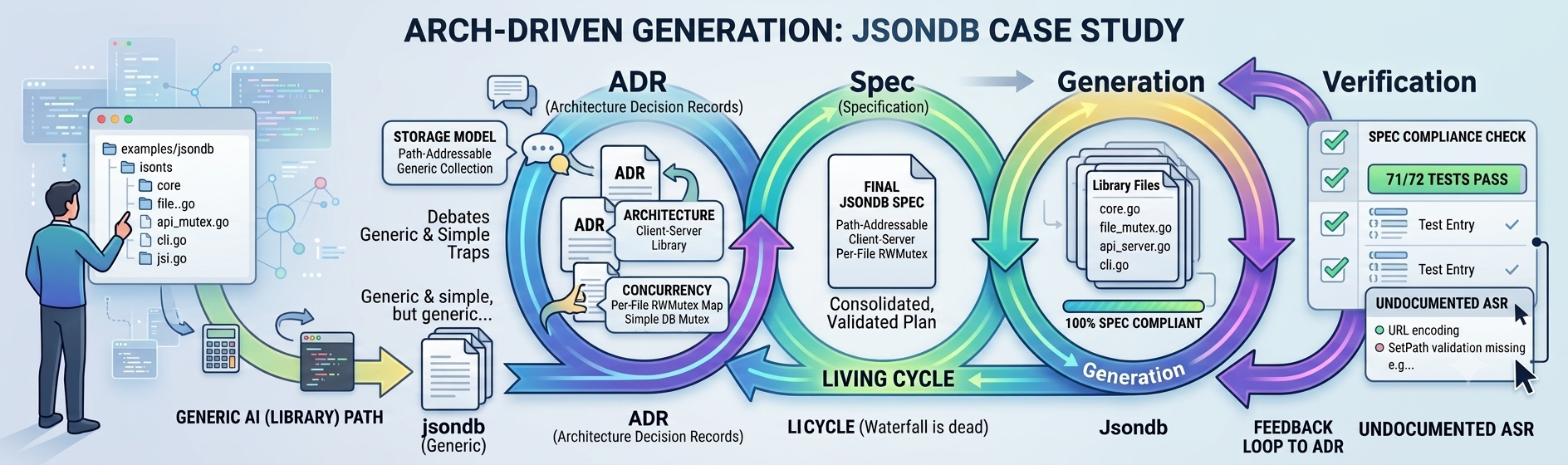
ADR → Spec → Generation → Verification. We'll walk through building software with AI using a real case.
💬 "Build jsondb" — But AI Insisted on Design First
Imagine you ask Cocrates:
"Develop jsondb in examples/jsondb."
A typical AI might say "jsondb? Got it!" and dump hundreds of lines of code—no review, no design, code first.
Cocrates answers differently:
"What will you use this jsondb for? I'll design the architecture first, get your review and approval, then generate code safely."
That's Cocrates' core value. Remember Ep2? "Unexamined output isn't worth generating." Cocrates is AI that honors that principle. No design, no review—no code.
Today we build jsondb—a simple local JSON store. Even this small project needed real architecture debates.
🏛️ ADR ① — Storage Model Debate: The "Generic" Trap
Situation: How do we store data?
AI's suggestion: "A Collection-Document structure like MongoDB is common and easy."
AI leads with "generic." The pattern it saw most in training.
But "generic" means "usually done this way"—not "right for my situation."
The user pushed back:
"No. I want path-based addressing—
Set("episode/e1.json")should createepisode/e1.jsonon disk."
That's Path-Addressable storage—different from Collection-Document.
They decided on path mapping.
💡 Lesson: Generic isn't always right for your needs. AI offered the most common pattern. Only you know the real context.
🏛️ ADR ② — Architecture Debate: The "Easy and Simple" Trap
Situation: How do we ship jsondb?
AI's suggestion: "Engine library + app is easiest—just import and use."
Sounds convenient. Import and go.
The user asked:
"What if another app needs to access this jsondb later?"
That flips everything. Library + app only works in-process. Multiple apps need Client-Server.
They moved from Library + app to Client-Server. The "easy" path didn't hold future needs.
💡 Lesson: Easy and simple doesn't always scale. AI favors the quickest implementation. You ask about the future to reach better structure.
🏛️ ADR ③ — Concurrency Debate: The "Quality" Trap
Situation: Concurrent requests—how do we handle them?
AI's suggestion: "One DB-level RWMutex is enough. Simple."
Technically valid.
The user anticipated performance:
"While writing one file, do all reads on other files have to wait?"
Exactly. One DB-level RWMutex blocks every read while any file writes. With 100 or 1000 files, that's a bottleneck.
They switched to a Per-File RWMutex Map—concurrent access to different files.
💡 Lesson: AI wasn't wrong technically—but quality (performance, scale) wasn't fully considered. You question performance to improve quality.
🎯 Lessons from ADRs — Three Reasons AI Suggestions Miss
Three ADRs, one important lesson:
AI suggestions can miss for many reasons—not just hallucination.
- Generic: AI offers the most common pattern. Generic ≠ right for you. (ADR ①: storage)
- Simple: AI favors easiest implementation. May not meet future needs. (ADR ②: architecture)
- Quality-blind: Technically fine but weak on performance or scale. (ADR ③: concurrency)
Recognizing these helps you review AI's first proposal more carefully.
📋 Spec — Integrating Decisions
After three approved ADRs, Cocrates merged every decision into one self-contained document—the Spec.
The Spec alone should fully explain what to build. No need to open ADRs.
- Storage: Path-Addressable (key → direct file path)
- Architecture: Client-Server (multi-process)
- Concurrency: Per-File RWMutex Map
⚙️ Generation — Code From Spec
Cocrates generated code from the Spec:
- 7 Go library files
- REST API server
- CLI
- All tests passing
Because generation followed the Spec, code matches decisions—no extra assumptions.
🔍 Verification — Spec Check and Unexpected Finds
Even Spec-based generation can diverge from Spec. Verification used 72 checklist items:
- 71: pass
- 1: fail — double slash (
//) in CLI schema URL
Important finding: 6 Undocumented ASRs.
Undocumented ASRs are structural decisions in the output not stated in the Spec—6 in this case:
- URL encoding approach
- Missing SetPath validation
- Four other implicit design choices
Undocumented ASR isn't failure. It's a chance to sharpen the Spec. Review those six in design and update.
🔄 Living Cycle — Structure Isn't Frozen
Many people mistake this for Waterfall.
Waterfall: design → implement → verify (done)
Reality is a cycle:
ADR → Spec → Generation → Verification
  ↑                            │
  └──────── feedback ←─────────┘
Problems in verification send you back to design—revisit ADRs, change them if needed. Requirements change? Same loop: ADR → Spec → regenerate → re-verify.
ADRs are living documents. Today's decision may not hold tomorrow.
Specs are living documents. When ADRs change, Specs must change.
Structure isn't set once and forgotten. Structure drives development; verification and changing needs improve structure.
Architecture-driven development isn't Waterfall. Structure leads development; development experience improves structure.
📌 Key Takeaways
- Review AI suggestions. Not just hallucination—Generic, Simple, or Quality-blind misses happen. User review and approval are essential.
- ADR and Spec are living documents. Verification or requirement changes send you back to design. Structure evolves.
- Verification is quality. Spec verification can't catch everything—but without verification you catch nothing. Undocumented ASR is a Spec improvement opportunity.
- Architecture-driven development is a Living Cycle. Structure leads; experience refines. Not Waterfall.
Ask yourself:
- Can you name the four stages of the Artifact Generation pipeline?
- Can you explain the three reasons AI suggestions miss—with examples?
- What is Undocumented ASR?
- Why isn't architecture-driven development Waterfall?
🎬 Coming Up Next
Today we experienced architecture-driven generation—ADR, Spec, Generation, Verification—in a real project.
Next, Ep6 goes further. Ep5 used existing skills; Ep6 we build a new skill with Cocrates—a skill for making skills.
Instead of "write a report," teach AI "how to write reports." Design and build a skill that auto-generates reports and documentation.
One closing question:
"Have I ever copy-pasted AI's first proposal without a second thought?"
This series introduces the Cocrates Harness framework. Cocrates is an agent harness designed for Socratic dialogue so users keep agency and grow.