EP11. Architecture-Driven Generation Skills
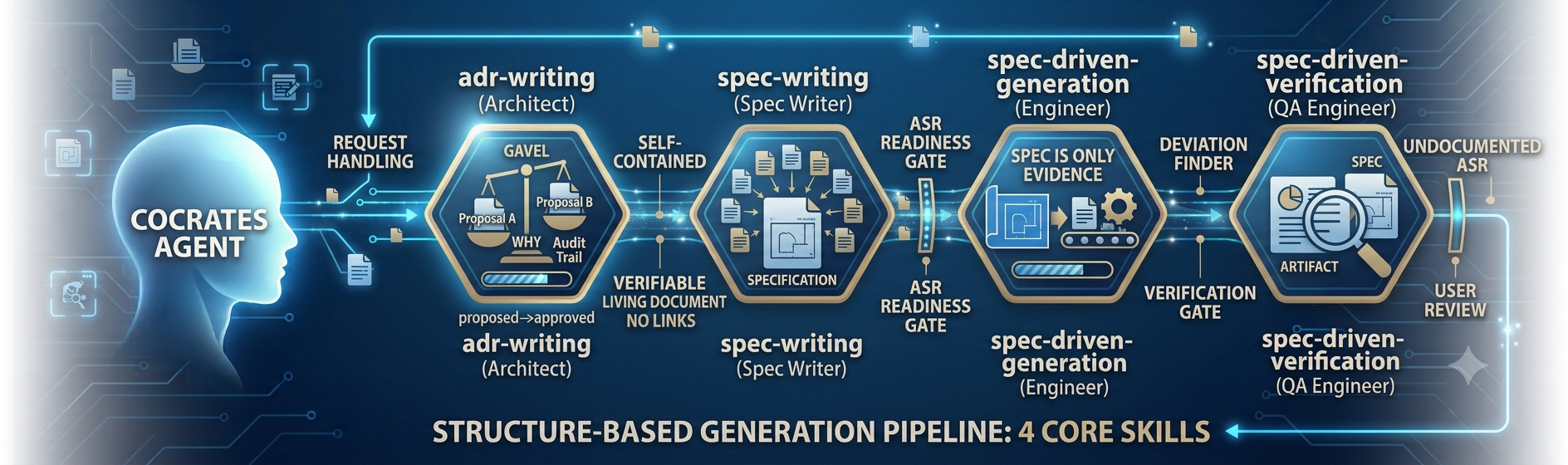
From Ep7 through Ep10 we explored Cocrates internals—Agent routing, Skill behavior, architecture-driven generation principles, Intent-To-Skill Routing.
We understand the why.
Now the question shifts:
"I get the principles. What skills does Cocrates actually have, and when does each run?"
Today we answer that. Ep11–Ep13 dissect core skills of the architecture-driven generation pipeline. Today: the four pillar skills and the full flow.
🎯 "Generate A" — Cocrates' Internal Reasoning
When Cocrates hears "Generate A," what happens inside?
First question: "Is there a dedicated skill for generating A?"
"Generate a blog series" → blog-series-authoring exists. Use it. Simple.
Second question: "If no dedicated skill?"
Fallback to spec-driven-generation—the generic core of the architecture-driven pipeline.
But spec-driven-generation isn't "go build." It asks finer questions.
Third question: "Is the Spec clear?"
If not—here's where it really starts. Cocrates walks through:
- ASR identification — what structurally matters for this artifact?
- ADR — alternatives and decisions per ASR
- Spec — merge all ADR decisions into one self-contained doc
- Spec readiness — is Spec concrete enough?
- Only then generation — after Spec is complete
That's why Cocrates never allows "build first, see later."
🏛️ Four Pillar Skills — The Generation Engine
The architecture-driven pipeline rests on four skills:
① adr-writing — Design the Decision
ADR (Architecture Decision Record) isn't a casual decision log. One Concern = one ADR—record design choices with audit trail.
Core rules:
- Compare at least 2–3 real alternatives
- Clear pros/cons per option
- Status:
proposed→ approved →approved - Record rejected options too—"why we didn't choose this" is future asset
Why it matters: Without ADR, rationale disappears. Later: "Why did we build it this way?"—no answer.
② spec-writing — Living Specification
Spec integrates ADR decisions into a self-contained document.
Core rules:
- No ADR links. Spec alone must explain everything. "See ADR 3" is forbidden.
- Verifiable statements. Not "must be fast" but "must handle 1000 requests per second"—pass/fail clear.
- Living document. Requirements change → Spec changes. Not write-once trash.
③ spec-driven-generation — Spec Is the Only Source
One iron rule in generation: Spec is the only authority.
Don't generate what's not in Spec. Don't add from AI intuition. If Spec is thin, strengthen Spec—don't improvise.
Cocrates runs an ASR Readiness Gate—eight universal categories to confirm Spec is ready.
Spec > prompt. No matter how clever the prompt, it can't replace Spec. Spec is verifiable, versioned, reproducible. Prompts evaporate.
④ spec-driven-verification — Start of the Cycle, Not the End
Verification isn't just testing. Two purposes:
Purpose 1 — Deviation: Does output match Spec? Find mismatches.
Purpose 2 — Undocumented ASR: Structural decisions in output not in Spec—not failure; chance to perfect Spec.
After verification, a user review gate remains. AI verified isn't done—you approve.
💡 Today's Insight: Skills as Specialized AI Roles
The biggest insight from Cocrates' skill system:
Skills give AI specialized roles.
adr-writing→ AI as architect designing decisionsspec-writing→ AI as spec author documentingspec-driven-generation→ AI as engineer implementing to specspec-driven-verification→ AI as QA engineer verifying
Not one AI wearing every hat—role-specific skills following defined procedures. Consistent quality, predictable outcomes.
📌 Key Takeaways
- Generation pipeline uses two decision layers. Dedicated skill for A? → use it. Else spec-driven-generation → Spec clear? → if not, ASR → ADR → Spec first
- Four pillar skills: adr-writing, spec-writing, spec-driven-generation, spec-driven-verification
- Spec > prompt. Spec is verifiable, versioned, reproducible; prompts are volatile
Ask yourself:
- Can you name Cocrates' four pillar skills?
- Can you explain spec-driven-generation's internal flow when it fallbacks?
- Why does Spec forbid ADR links?
🎬 Coming Up Next
Today we surveyed which skills build the architecture-driven pipeline.
One question remains:
"What if the skill I need doesn't exist?"
Say you need a "regular code review report generator." No such skill in Cocrates. What then?
Ep12: "How to create a skill when there is no skill."
Cocrates offers generating-skill-creation—a meta-skill. Next time we go deeper into the skill that makes skills.
This series introduces the Cocrates Harness framework. Cocrates is an agent harness designed for Socratic dialogue so users keep agency and grow.