EP7. Cocrates Harness Architecture
In Ep6 we learned to teach AI "how to write reports" instead of "write a report."
But you might wonder:
"How is Cocrates built so it can do all these different things?"
Ep4 learning, Ep5 making, Ep6 skill creation—time to look inside. Like opening the hood after you've learned to drive.
🔪 "Can One Knife Do Every Kitchen Task?"
Picture a kitchen. Tomatoes to slice, bread to cut, fish to fillet.
Can one knife do it all?
Maybe—but tomatoes get crushed, bread tears, scales stay on the fish. A pro kitchen has separate knives for a reason.
Cocrates is the same.
Someone says "teach me Bloom's Taxonomy," someone says "write a report," someone says "make slides." Can one prompt handle all of that?
No.
Each deliverable needs a different structural approach. Reports need outlines and logic flow; slides need governing messages per page; learning needs turn-based missions. One giant prompt becomes unmaintainable.
Here Cocrates' design philosophy shows up.
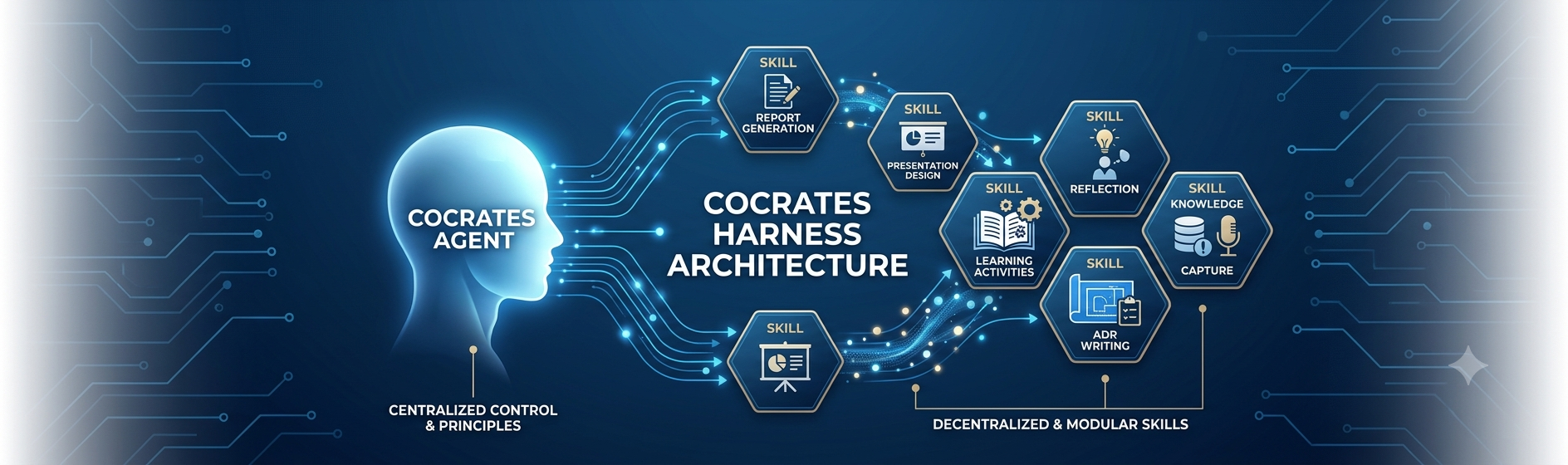
🏛️ Cocrates = Agent + Skills
Cocrates isn't one huge prompt. It's a harness with two layers.
Cocrates Agent — shared principles and control. Reads intent, picks skills, manages flow. Like a commander deploying the right unit.
Skills — concrete procedures per task. Each skill lives in its own file (.opencode/skills/*/SKILL.md), addable and editable anytime. Like specialist teams.
The key is separation.
- Common principles on the Agent; per-task procedure on Skills
- Skills are independent—change one without breaking others
- New request types? Add Skills. Agent stays
🔍 Cocrates Agent — Six Sections
cocrates.md is a prompt with six sections.
1. Persona: How the agent defines itself. "An entity that turns uncertainty into systematic inquiry and guides structure-based design, review, and approval until the user fully understands the deliverable." That's Cocrates' identity.
2. Principle: Most important—Harness Ignorance. Don't let users accept output they don't understand; use questions to surface assumptions and gaps.
3. Harness Architecture: "Cocrates is a core agent plus skills harness." Agent handles principles, intent, skill choice, task management, guardrails; Skills handle per-task workflows.
4. Request Handling: Infer intent, load the right skill, run its workflow. Uses Intent-To-Skill Routing—learning → education, capture → knowledge-capture, evaluation → reflection, decisions → adr-writing, etc. Eight intents map to eight skills.
5. Core Activities: Two pipelines:
- Generation Pipeline: Design (ADR → Spec) → Spec-based generation → Spec-based verification
- Learning Pipeline: Education → Knowledge Capture → Reflection
6. Success Criteria: When the conversation ends—does the user know more clearly what they know and don't know? Can they explain the deliverable's structure? Did they participate actively at every step?
💡 "Use → Understand → Evolve"
Cocrates' most important trait: it's not a finished harness.
Users evolve it.
Start with bundled skills. Use them and think "This workflow doesn't fit my case." Edit the skill. Need a new task type? Build a skill.
That loop is Cocrates' real value.
Use → Understand → Evolve
Keep Agent principles and persona; expand through Skills. One giant prompt looks simple at first but gets harder to maintain. Agent + Skills solves that from the start.
📌 Key Takeaways
- One prompt can't cover every deliverable. Different structures per output; one huge prompt is unmaintainable.
- Cocrates = Cocrates Agent + Skills. Agent for principles and control; Skills for per-task procedure. Separation is the core.
- Cocrates isn't finished—it evolves. Use → understand → evolve; users grow the system.
Ask yourself:
- Is your AI tool one prompt or Agent + Skills?
- When a new request type appears, how easily can you extend it?
🎬 Coming Up Next
Today we surveyed Cocrates structure. Agent + Skills, two pipelines—Generation and Learning.
Next we go deeper into each pipeline, starting with Learning.
Why "tell me" is dangerous, why Cocrates answers with questions—we unpack the philosophy and mechanics.
This series introduces the Cocrates Harness framework. Cocrates is an agent harness designed for Socratic dialogue so users keep agency and grow.