EP13. Using Cocrates Harness Well
In Ep1 we asked: "How many AI teammates do you have?"
In Ep2 we set the principle: "Unexamined output isn't worth generating."
In Ep3 we prepared the tool—installed Cocrates Harness.
In Ep4–6 we practiced—learning, generation, skill creation.
In Ep7–10 we understood internals—Agent, Skill, routing, architecture principles.
In Ep11–12 we learned core and meta-skills.
We now know all of Cocrates.
So what should we do? Just use it?
No. The real part starts now.
💭 "Is This the End?"
Honestly, I asked myself:
"I installed Cocrates, learned how to use it, understood the internals. Now what—just use it hard?"
But Cocrates' real value isn't in using it—it's in evolving it.
Cocrates isn't a finished product. It's a growing framework. And it grows with the user.
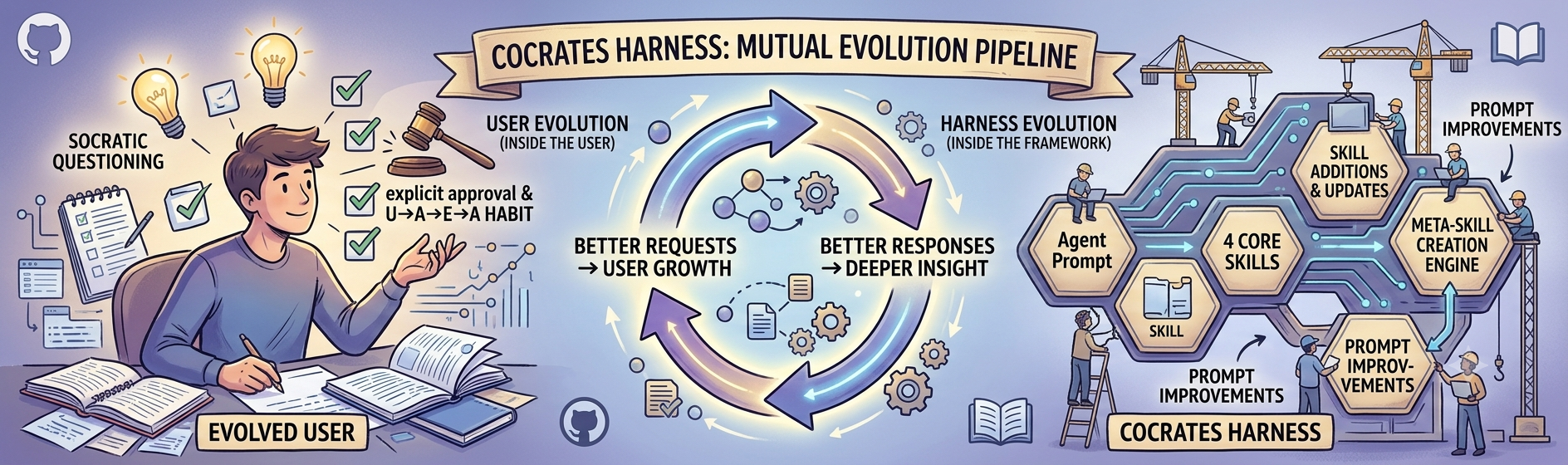
🧑🎓 Users Must Evolve
The first condition for using Cocrates well: you evolve.
Internalize Socratic questioning.
At first Cocrates asks: "What's the purpose of this design?" "Why this approach?" You answer and learn to think.
Eventually you ask yourself—without Cocrates—"What's my rationale for this decision?"
Habituate review (U→A→E→A).
Understand, analyze, evaluate, approve—from Ep2. At first it's conscious; eventually it should be habit.
When you get AI output, not "looks fine" but natural U→A→E→A.
Habituate explicit approval.
Review without approval equals no review. Not "I skimmed it—probably okay" but "I've checked. We're going with this. I'm accountable."
Those three are the core of user evolution.
🤖 Cocrates Harness Must Evolve Too
Users aren't the only ones who must grow—Cocrates Harness must evolve.
Add, edit, extend skills.
Start with bundled skills; over time you need your own. Use generating-skill-creation from Ep12—build, edit, refine skills.
When work patterns change, skills change. Skills are living assets, not frozen.
Improve agent prompts.
Cocrates Agent prompts are evolution targets too. Early prompts are generic; experience can sharpen them.
"This request type comes up often—how should I change the prompt so Agent handles it better?"
You should be able to ask yourself that.
🔄 Mutual Evolution — Feedback Loop
User evolution and Cocrates evolution aren't separate—they form one feedback loop.
User growth → better requests → better Cocrates responses → deeper insight → user growth
Repeat that and both strengthen.
Break the loop? User stops growing → Cocrates stagnates. Don't update Cocrates → user hits limits.
That's the real meaning of Ep1's question. "How many AI teammates do you have?" isn't just productivity—it's how well you lead AI teammates and grow together.
🌍 Open Source Philosophy — Code Waiting for Your Evolution
Cocrates is open source. All code and prompts are public.
github.com/cocrates/cocrates.ai
You don't have to stay a consumer. You can contribute—share skills, fix bugs, propose better prompts.
And Cocrates isn't locked to one IDE or plugin. Claude Code, Cursor, Codex, opencode—you can implement Cocrates principles and skills anywhere. Cocrates is methodology, not just a tool.
💡 Today's Insight: The Unexamined Code Applies to the Framework Too
Remember the series' core principle?
"The unexamined code is not worth generating."
It doesn't apply only to code—it applies to Cocrates Harness itself.
Cocrates must be continuously reviewed, analyzed, evaluated, improved. "It's Cocrates—it must be fine" is sliding back to blind AI-assisted trust.
Using Cocrates isn't enough. You must evolve Cocrates.
📌 Key Takeaways
- Users must evolve—internalize Socratic questions, habituate U→A→E→A, explicit approval.
- Cocrates Harness must evolve—skills and agent prompts.
- Mutual evolution is a feedback loop—sustainable growth engine.
- Cocrates is open source—be a contributor, not only a consumer.
- The principle applies to the framework too—unexamined code includes Cocrates' own code.
Ask yourself:
- Am I satisfied with using Cocrates—or evolving it?
- Have I created or edited a Cocrates skill recently?
- Have I read Cocrates source code?
🎬 Coming Up Next
Thirteen episodes—a long journey together.
Philosophy and principles, install and practice, internals and skills, mutual evolution.
One episode remains.
Ep14 — Cocrates Harness User Manifesto.
All teachings condensed into seven commandments. A declaration for engineers in the AI age—not replaced by AI, but growing without limit as AI-native engineers using AI.
The series' opening principle returns as the closing line:
"The unexamined code is not worth generating."
This series introduces the Cocrates Harness framework. Cocrates is an agent harness designed for Socratic dialogue so users keep agency and grow.