EP1. Same LLM, Different Results
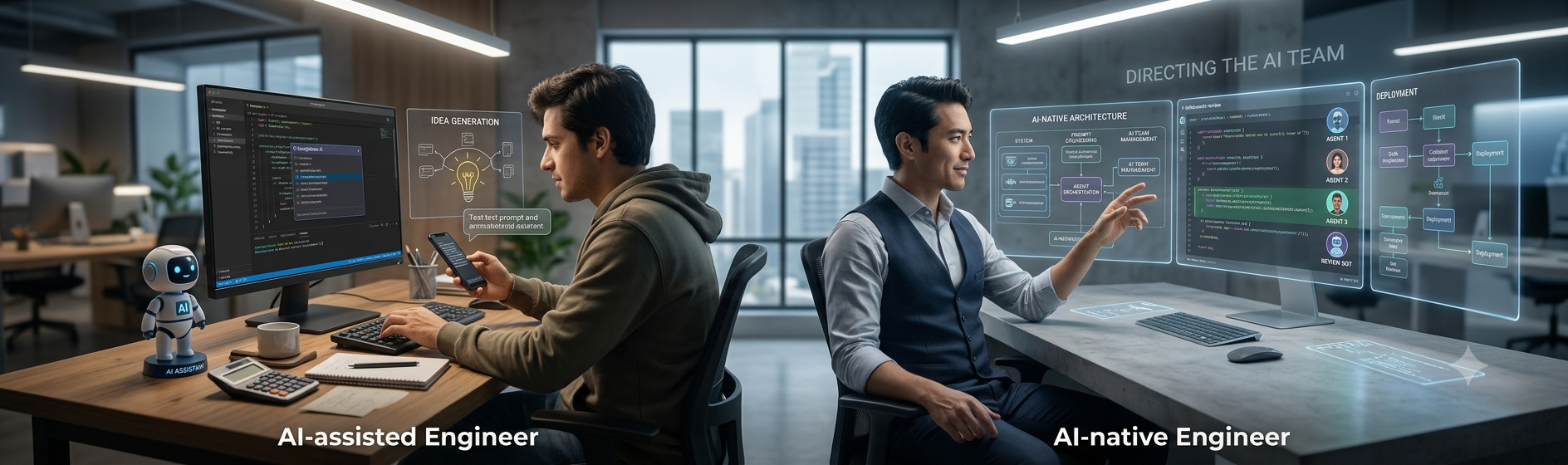
"ChatGPT, write me a login module!"
If you're a developer, you've probably thrown out a request like this several times a day—using the same Claude, the same GPT. And yet the results can be wildly different.
Some people copy-paste AI-generated code until they're pulling all-nighters. Others calmly steer the work as if they were leading a team of ten brilliant engineers. The tool is identical—so why does the gap exist?
Finding an answer to that question is where today's story begins.
🚨 Developer A's Day — "Whatever AI Says"
Busy junior developer A is racing a deadline again. In a hurry, they ask the AI:
"Add a login module."
The AI quickly produces plausible-looking code. A pastes it into the project without much thought. "AI probably got it right, anyway." It runs for now—relief.
But the real problem shows up a week later.
Security review flags a session-management vulnerability—or an interface mismatch with another module. A, who pasted code they never understood, ends up rewriting everything from scratch through another sleepless night.
The codebase grows, but A's head fills with things they don't know—snowballing ignorance.
Does this sound familiar? "Yeah, I do that sometimes too..."
🤝 Developer B's Approach — "Thinking With AI"
Developer B, same tenure, also needs a login module. But the relationship with AI is completely different.
"Our project will have around 100,000 users and security is critical. First, suggest authentication approaches we could use and compare the trade-offs of each."
When the AI offers session-based auth, JWT, OAuth 2.0, and more, B goes back and forth with it—designing the best structure for the project's future (mobile app scalability, etc.).
Only after an hour of intense discussion and a locked-in architecture does B ask for code. The result may look similar to A's on the surface—but B fully understands why it's designed this way, why error handling follows this pattern, and every design rationale behind it.
What's the difference? Technology? LLM version? No. It's attitude.
🔍 AI-assisted Engineer vs AI-native Engineer
The gap between A and B isn't simply a skill gap—it's a difference in how you relate to AI.
| AI-assisted Engineer | AI-native Engineer | |
|---|---|---|
| AI's role | A tool that helps me (like a calculator) | A teammate who does the work |
| Your role | Do the work yourself with AI's help | Direct, review, and approve |
| Review style | "AI probably got it right" → move on | "Do I understand this?" → review, then approve |
| Outcome | More code↑, less understanding↓, more ignorance↑ | More code↑, more understanding↑, more capability↑ |
A is an AI-assisted Engineer. AI is just a tool—a helper like a calculator. Use it when you need it and move on.
B is an AI-native Engineer. AI does the work; you lead as the team lead. You direct, AI executes, and you review, understand, analyze, and evaluate before you approve. AI isn't a tool—it's a teammate working on your behalf.
Whether you see AI as a tool or a teammate—that's the line between AI-assisted and AI-native.
💡 "Is That Really Possible?" — OpenAI Proved It
Many engineers push back here:
"Wait—you're saying I delegate work to AI and just review? Is that actually realistic?"
It's a natural question. And there's a clear answer.
Yes. It's already been proven in practice.
In April this year, OpenAI engineer Ryan Lopopolo shared the following:
- Three engineers built one million lines of production code in five months.
- And critically—they didn't write a single line by hand.
- They moved 10× faster than traditional development.
The team ran multiple autonomous AI coding agents through a system called Symphony. What was the human role? Architect & Gardener—design the system and review what the agents produced.
Lopopolo described their role this way:
"Group tech lead for a 500-person organization"
Three people delivered the output of a 500-person org. That's what an AI-native engineer looks like in practice.
🎯 How Many AI Teammates Do You Have?
We've established that the AI-native approach is possible. So the question changes.
It's no longer "Is it possible?" It's this:
"How many AI teammates do you have?"
Working in an AI-native way means treating AI as teammates.
- One? — You can delegate one person's worth of work to AI and review it.
- Four? — You can delegate four people's worth.
- Ten? Twenty? — You can run AI teammates like a small team you lead.
How many AI teammates are you leading right now? Or rather—how many could you lead?
Ultimately, your capability matters. Just as a manager's skill determines team size, an AI-native engineer's skill determines how many AI teammates they can run.
So how do you build that capability?
🦉 Cocrates Harness — Mutual Socratic Relationship
Cocrates is an agent harness that helps you become an AI-native engineer.
Cocrates is Co + Socrates—a mutual Socratic relationship.
You are Socrates to the AI.
AI only generates the most plausible answer probabilistically. You ask questions, review, and judge to keep it from producing what's wrong. That's the core skill of an AI-native engineer.
The AI is also Socrates to you.
It stops you from making vague requests or approving output you don't understand. It won't let you hand-wave what you only half know. Like Socrates, it surfaces your ignorance and helps you grow your own capability.
Cocrates is an agent harness that makes you use AI in this mutual Socratic relationship—the tool for leading AI teammates as an AI-native engineer, and the right way to use AI.
📌 Key Takeaways
- Same LLM, different results. It's not AI performance—it's your approach that shapes the outcome.
- AI-native Engineer. Someone who directs AI's work, reviews it, and approves it. Review and approval are what separate AI-assisted from AI-native.
- "How many AI teammates do you have?" The answer depends on your capability—one, ten, or more. What matters is your capability.
Take a moment to ask yourself:
- "Am I an AI-native engineer right now—or still AI-assisted?"
- "Of the requests I made to AI today, how many did I review in an AI-native way?"
The first step toward being AI-native is self-awareness.
🎬 Coming Up Next
Today we learned what the problem is: attitude. The gap between AI-assisted and AI-native engineers isn't technology—it's attitude.
So what's the core skill an AI-native engineer must have?
Review. Understanding, analyzing, evaluating, and approving what AI produced. That act of review is the most important work of an AI-native engineer.
Next episode, we declare the principle that runs through this entire series:
"The unexamined code is not worth generating."
We'll unpack why this one line is a weapon for AI-native engineers—and what examination really means.
This series introduces the Cocrates Harness framework. Cocrates is an agent harness designed for Socratic dialogue so users keep agency and grow.