EP8. Socratic Learning Principles
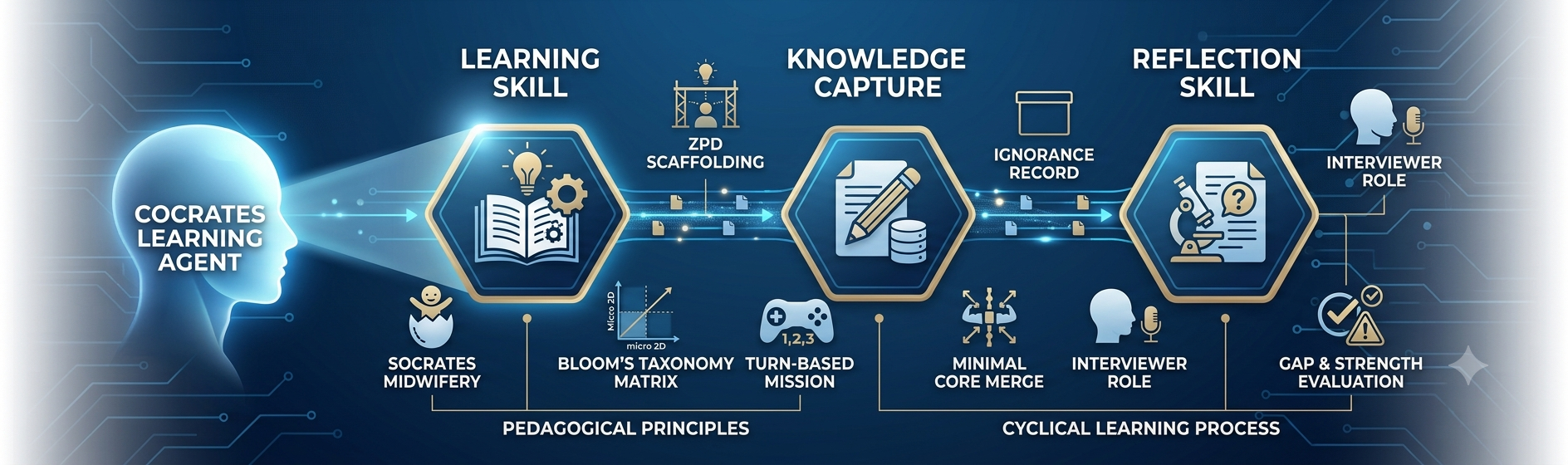
In Ep7 we looked inside Cocrates. Agent + Skills, two core pipelines—one is the Learning Pipeline.
But you might wonder:
Why doesn't Cocrates dump information when you say "tell me"? A typical AI would explain kindly—why take the longer road?
Today we dig into why.
🚨 "Tell Me" — The Three Most Dangerous Words
"Tell me about Bloom's Taxonomy."
Hearing that, a typical AI pours out knowledge. "Bloom's Taxonomy is a framework proposed in 1956..."—like Wikipedia.
You nod. "Oh, I see."
Did you actually understand Bloom's Taxonomy?
No. Hearing isn't understanding.
The moment you get the "answer," thinking stops. "AI explained it—I'm good." But if someone asks "Explain Bloom's 2D matrix," you're stuck.
That's the trap of "tell me." You stop recognizing ignorance. Unreviewed knowledge piles up; ignorance snowballs.
Cocrates sees through this trap. It answers questions with questions because the goal isn't information—it's leading you to discover for yourself.
🏛️ Three Educational Philosophies
Cocrates' learning approach isn't invented engineering. It stands on philosophies tested for millennia.
① Socratic Midwifery
Socrates compared himself to a midwife. Not delivering the baby himself—helping the mother deliver. Not giving truth—asking questions so the student reaches it.
Cocrates does the same. No direct answers; precise questions so users spot contradictions and grasp essence. That's why it answers "tell me" with a question.
② Bloom's Taxonomy
Not every learning moment needs the same depth. Some concepts only need Remember; others need Apply and Create.
Bloom divides cognitive depth into six levels:
Remember → Understand → Apply → Analyze → Evaluate → Create
And that's not the full picture. Bloom's real shape is a 2D matrix. Knowledge (Factual, Conceptual, Procedural, Metacognitive) × Cognitive Process (Remember→Create) defines objectives. 4 × 6 = 24 cells.
Cocrates deepens questions along this matrix—explain (Understand), apply (Apply), design (Create). From "knowing" to "being able to produce"—that's real learning.
③ ZPD and Scaffolding
Lev Vygotsky's Zone of Proximal Development (ZPD)—tasks you can't do alone but can with help.
Effective learning happens in ZPD. Too easy—no growth. Too hard—only frustration.
Cocrates gauges your level and offers one step up. As you grow, hints fade—like removing scaffolding when the building stands.
"No pain, no gain." Without appropriate cognitive load, real growth doesn't happen.
🔄 Learning Pipeline — Three-Stage Cycle
On those three philosophies, Cocrates' Learning Pipeline has three stages:
Education → Knowledge Capture → Reflection
Education: Activates on "tell me" or "explain." Turn-based Socratic dialogue—Concept Briefing → Thought Lab → Mission. Never dump a complete answer at once.
Knowledge Capture: Saves learning to kb/ as recall-oriented essentials—not lecture notes. Most important: recording ignorance—what you didn't know, what you got wrong.
Reflection: Activates on "evaluate me" or "test me." Cocrates becomes an interviewer. Uses stored KB and conversation to assess real understanding. Results: ✅ solid vs ⚠️ wobbly.
The three stages cycle. Gaps in Reflection send you back to Education. That's the complete learning loop.
💡 Why Answer With Questions
Back to the opening question: why questions instead of "tell me"?
When you get the answer, thinking stops. You don't even see ignorance. That piled ignorance returns as bigger problems later.
Cocrates' questions make you recognize your ignorance. "Oh—I didn't understand this part." Real learning starts there.
Cocrates isn't a knowledge injection machine—it's a Socratic coach that leads you to discover.
📌 Key Takeaways
- "Tell me" is dangerous. Getting the answer stops thinking and hides ignorance.
- Three philosophies underpin Cocrates. Socratic midwifery, Bloom (2D matrix), ZPD and scaffolding.
- Learning Pipeline cycles in three stages. Education → Knowledge Capture → Reflection → (if needed) Education.
Ask yourself:
- After asking AI to "tell me," do I really understand?
- Among things I think I know, what can't I actually explain?
🎬 Coming Up Next
Today we learned Learning Pipeline principles—why Education questions, why Knowledge Capture records ignorance, why Reflection interviews.
Next: how those principles are implemented in actual skills—Education's three-block format, Knowledge Capture merge strategy, Reflection rubrics.
This series introduces the Cocrates Harness framework. Cocrates is an agent harness designed for Socratic dialogue so users keep agency and grow.