EP4. Socratic Learning in Practice
This moment has arrived.
In Ep3 we installed Cocrates Harness. We verified Plugin and Skill. We're ready for the first question.
So we asked:
"Tell me about Bloom's Taxonomy."
A perfectly ordinary question. But Cocrates' answer was... anything but ordinary.
Today we tell the story from that moment on.
🤷 "Do You Know Bloom's Taxonomy?"
First, a question for you:
"Do you know Bloom's Taxonomy?"
Most people probably don't. That's fine—I thought I knew Bloom's Taxonomy before this conversation too.
Here's what matters:
Don't be ashamed of not knowing—ask AI.
That's the practice behind Ep2's "Never leave ignorance unattended." Don't know? Ask. Learn. Record. Verify.
💬 Same Question, Completely Different Answer
What happens if you ask a typical AI about Bloom's Taxonomy?
Probably something like:
"Bloom's Taxonomy is a framework proposed by Benjamin Bloom in 1956 that classifies the cognitive domain into six levels. First, Remember... Second, Understand..."
You lose focus in about three seconds. Too much information dumped at once.
Cocrates answered completely differently:
"Bloom's Taxonomy is famous for its six-level pyramid. But imagine a teacher designing a class that goes strictly from the bottom (Remember) to the top (Create). What's seriously wrong with that approach?"
One or two sentences on the core idea, then a question that makes you think.
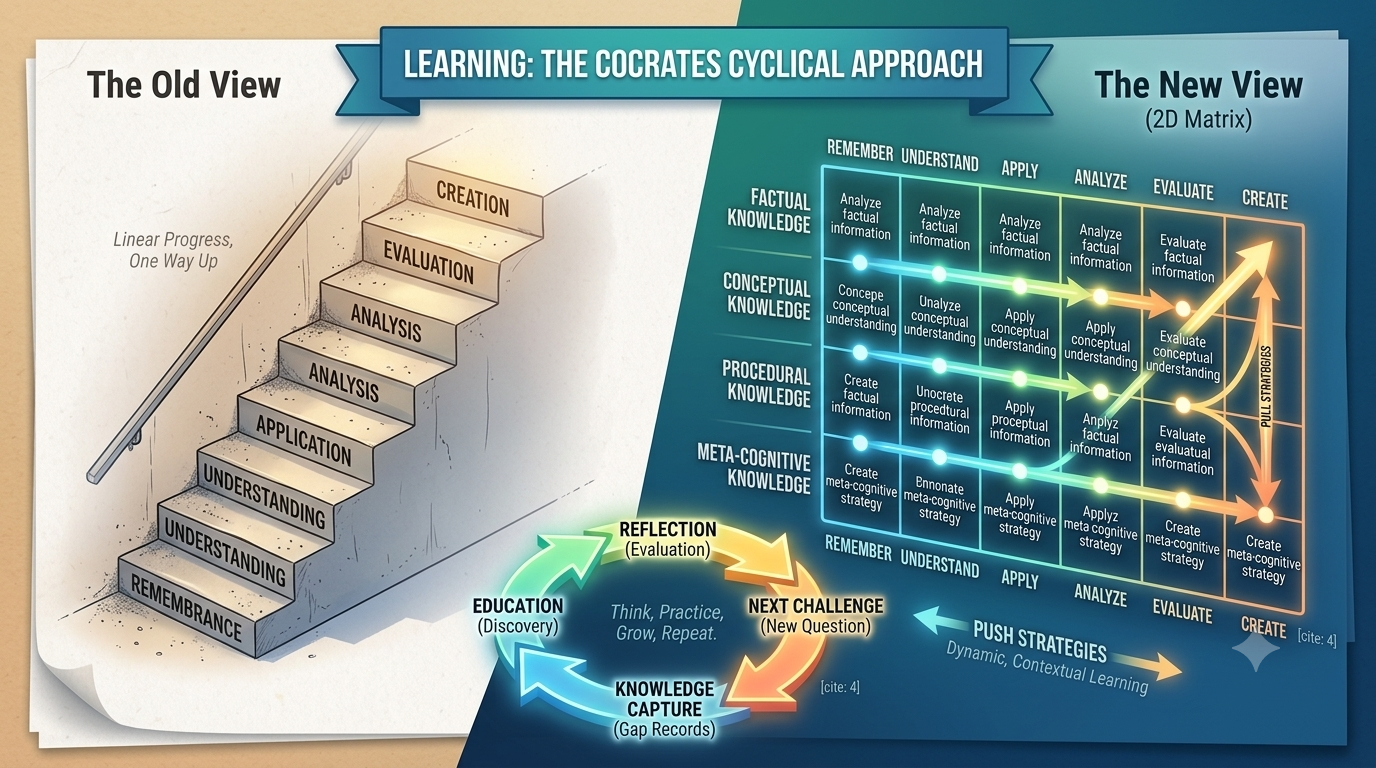
For those who don't know Bloom's Taxonomy: it's a six-level pyramid. Higher levels demand more advanced thinking.
Remember → Understand → Apply → Analyze → Evaluate → Create
Many people mistake the pyramid for a lesson sequence—"You must master the foundation perfectly before moving up."
Cocrates' first question targets exactly that misunderstanding.
Cocrates isn't a vending machine. It's a coach that makes you think.
🎯 Mission ① — The Pyramid Isn't a Lesson Sequence
The user wrestled with Cocrates' question—and discovered something striking:
The pyramid isn't a lesson sequence; it's a dependency structure.
The old belief breaks: "You must master the basics perfectly before moving on."
In practice, the reverse approach often works better.
"Okay—today build your own programming website! (Create)"
Throw a high-level task first, and students hit walls, search for syntax (Remember), and wonder why the code runs that way (Understand).
That's the Pull strategy—a high-level task pulls lower-level knowledge into play.
🎯 Mission ② — The 2D Matrix
Cocrates kept asking:
"Bloom's Taxonomy isn't a simple 1D pyramid. It's actually a 2D matrix. The intersection of Knowledge Dimension and Cognitive Process defines each learning objective. Map a concept you recently learned onto this matrix."
The user gained a second insight:
Bloom's Taxonomy isn't 1D—it's a 2D matrix.
The revised taxonomy isn't just a six-step pyramid. Knowledge Dimension × Cognitive Process defines each learning objective.
- Knowledge: Factual, Conceptual, Procedural, Metacognitive
- Cognitive Process: Remember, Understand, Apply, Analyze, Evaluate, Create
4 × 6 = 24 cells—that's Bloom's real shape. The same concept needs different learning design depending on which knowledge type you emphasize.
🎯 Mission ③ — Push and Pull
Cocrates asked one more question:
"Explain the relationship between Push strategy, Pull strategy, and ZPD (Zone of Proximal Development), and summarize when to use each."
A third insight:
Push (sequential) and Pull (challenge-first) should switch based on the learner's state.
- Push: Step-by-step guidance. Good for beginners. Effective at Remember and Understand.
- Pull: A high-level task pulls learning. Good when basics exist. Effective at Create and Evaluate.
- ZPD: Tasks you can't solve alone but can with help (scaffolding). Cocrates aims missions in that zone—not too easy, not too hard.
📝 Knowledge Capture — Record Gaps, Not Summaries
After three missions, the user asked to "summarize it."
Cocrates didn't produce a perfect summary of Bloom's Taxonomy. Instead it wrote to kb/bloom-taxonomy.md:
- Core definition: "Bloom's Taxonomy = 2D matrix (Knowledge × Cognitive Process)"
- Wrong assumptions (Gap): "I treated the pyramid as a lesson sequence. It's actually a dependency structure."
- Push/Pull strategy: "Push for beginners, Pull when basics exist. Mix based on ZPD."
Recording what you didn't know—not a summary. That's the heart of Knowledge Capture.
🔍 Reflection — Interviewer Mode
Final step. When the user asked to "evaluate me," Cocrates became an interviewer.
Four missions:
Mission 1 (Apply): "Map DIP (Dependency Inversion Principle) onto Bloom's knowledge dimension."
Mission 2 (Analyze): "Explain the difference between hierarchy and sequence, and how that affects learning design."
Mission 3 (Evaluate): "Which is more effective from a ZPD perspective—Push or Pull? Evaluate with reasons and conditions."
Mission 4 (Create): "Design a 4-hour Git branching curriculum based on Bloom's Taxonomy."
Cocrates returned a clear report card:
| Area | Status |
|---|---|
| Bloom basics (definition, six levels) | ✅ Solid |
| 2D matrix (Knowledge × Cognitive) | ✅ Solid |
| Push/Pull and ZPD | ⚠️ Wobbly—confusion on conditional use |
| Curriculum design (Create level) | ⚠️ Wobbly—needs clearer Git branching hierarchy |
⚠️ Wobbly areas are the real learning targets. Focus there and the next cycle begins.
🔄 The Full Cycle
The whole process is one loop:
Education (learn) → Knowledge Capture (record) → Reflection (verify) → (if needed) Education (more learning)
Learning with Cocrates doesn't end at "tell me." Question → insight → record → verify → (if needed) question again—that cycle completes real understanding.
📌 Key Takeaways
- Same question, different answer. Cocrates doesn't dump information—it asks questions that make you think.
- Three insights. Pyramid as dependency (Pull), not lesson sequence. 1D → 2D matrix (Knowledge × Cognitive). Push vs Pull depends on learner state.
- Learning pipeline in three steps. Education (inquiry) → Knowledge Capture (record, especially Gaps) → Reflection (verify, interviewer mode).
Ask yourself:
- Can you explain the knowledge and cognitive axes of Bloom's 2D matrix?
- Can you map a recent concept onto that matrix?
- Among things you think you know well, what's actually ⚠️ wobbly?
🎬 Coming Up Next
Today we experienced the Learning pipeline—Cocrates' first core activity.
But Cocrates has another core activity: architecture-driven artifact generation.
Next, Ep5 starts like this:
"Develop jsondb in cocrates/jsondb."
When you ask AI to "build it," how does Cocrates respond? More than code generation—a remarkable process unfolds.
This series introduces the Cocrates Harness framework. Cocrates is an agent harness designed for Socratic dialogue so users keep agency and grow.