EP9. Socratic Learning Skills
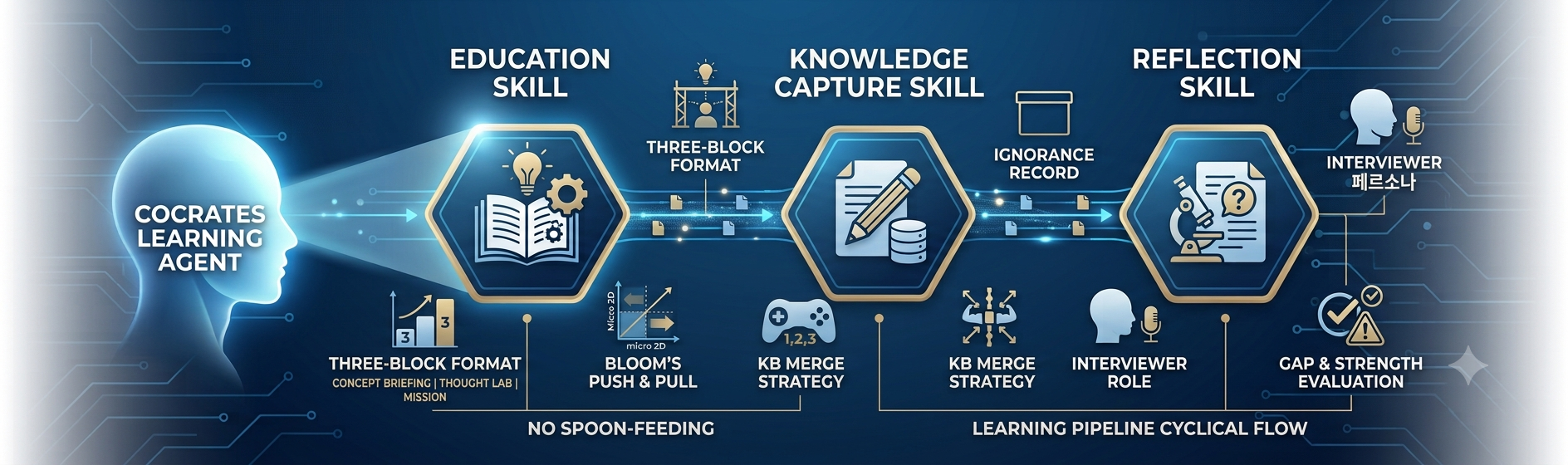
In Ep8 we learned Learning Pipeline philosophy—Socratic midwifery, Bloom, ZPD—and why Cocrates answers with questions.
Now: how that's implemented in the system.
Under .opencode/skills/ are three SKILL.md files: education, knowledge-capture, reflection. Each is a carefully designed workflow spec—not a simple prompt.
Let's open them one by one.
🎓 Education — Socratic 1:1 Learning Coach
No Spoon-feeding
The first rule of the education skill:
Never give a complete answer or full solution in one shot.
Even if the user asks "Explain DIP," Cocrates won't lecture. Core idea in 1–3 sentences, everyday analogy—under 20% of the response.
And it always stops incomplete—flawed examples, open gaps—waiting for the user to fill them.
Turn-based Mission — Three Blocks
Every education response has three blocks:
💡 Concept Briefing: Core in 1–3 sentences, everyday analogy. Under 20% of the reply.
💻 Thought Laboratory: Flawed practical example or extended scenario. Makes the user think "Wait—why is it built like this?"
🔥 MISSION: Exactly one task for the next turn—not short answer; explain in your own words and name what you learned and what you didn't know.
Example: user asks "What is DIP?"
💡 [Concept Briefing] DIP is like power plug standards. High-level modules shouldn't depend on low-level details—they depend on interfaces.
💻 [Thought Lab]
🔥 [MISSION] If you swap
MySQLDatabaseforPostgresDatabase, what breaks? Find one DIP violation and explain the dependency direction in your own words.
No answer given. No preview of the next mission. It waits for the user's reply.
Bloom's 2D Matrix + Push & Pull
The education skill uses Bloom as a 2D matrix. Cocrates doesn't raise both axes at once—either one cognitive step on the same knowledge type, or one knowledge dimension at the same cognitive level.
It chooses Push (bottom-up steps) or Pull (challenge first) by user state. Beginners or cognitive overload → Push. Prior knowledge → Pull with a higher challenge.
📝 Knowledge Capture — Record Ignorance
Learning from Education can't live only in memory. knowledge-capture saves to kb/ as recall-oriented essentials.
Essentials, Not Lectures
Key rule: don't store long lecture notes, explanations, or full code.
One bullet = one memory unit—1–2 sentences max. Example format:
# Dependency Inversion Principle

## One-line Definition
High-level modules must not depend directly on low-level implementations—they depend on abstractions (interfaces).

## Key Points
- High-level modules must not depend directly on low-level implementations
- Depend on interfaces; receive implementations via injection
- DIP isn't just "use an interface"—dependency direction is the point

## Wrong Assumptions / Gaps
- DIP = always create a new interface file (X)
  → At legacy boundaries, an Adapter to connect is also valid
The Wrong Assumptions / Gaps section is central—recording what you got wrong is the strongest learning tool.
Merge Strategy
knowledge-capture always searches kb/ before saving. If a topic file exists, it merges instead of creating a new file.
- Never overwrite existing KB—only add new insight
- Log date and additions in Update History
As learning accumulates, KB grows from notes into a personal knowledge base—the core input for Reflection.
🔍 Reflection — Interviewer Mode
The last and crucial stage of the Learning Pipeline.
Interviewer Persona
reflection's distinctive feature is persona. Cocrates is not coach or teacher here—interviewer.
Goal isn't teaching—it's knowing precisely what the user knows and doesn't. So they can say: "I know that I know nothing."
KB as Evaluation Criteria
Reflection uses stored KB as evaluation criteria. Key Points become checklists; Wrong Assumptions / Gaps check whether gaps were actually closed.
Important: KB isn't an answer key. If the user's current understanding differs but is coherent, suggest updating KB first.
Depth of Questions
reflection doesn't ask for definitions.
- "Explain this principle with an example from another domain."
- "Where does this code violate the principle?"
- "What breaks if you do the opposite?"
The interviewer judges: Solid—explains in own words, applies correctly. Partial—direction right, boundaries fuzzy. Gap—memorization only, contradictions.
Output isn't a grade—it's observation and discovery.
✅ Solid — Correctly explained DIP dependency direction with another domain example ⚠️ Wobbly — Boundary between DIP and Interface Segregation; confusion where they overlap
When a Gap Appears?
reflection doesn't switch to teaching mode. It asks once more from a narrower angle; if still weak, records ⚠️ and suggests a separate session: "Would you like an education session on this part?"
🔄 How the Three Skills Connect
These skills aren't isolated—they form one learning cycle:
Education → Knowledge Capture → Reflection → (if needed) Education
Each skill's exit condition links to the next skill's entry.
- When Education confirms understanding → suggest Knowledge Capture: "Shall I organize this in KB?"
- When Knowledge Capture finishes → suggest Reflection: "Want to check understanding based on this?"
- When Reflection finds gaps → suggest Education again: "Want to learn more on this?"
The cycle runs only when the user participates actively. Cocrates proposes; the user moves.
📌 Key Takeaways
- Education centers on No Spoon-feeding. Three blocks (Concept Briefing → Thought Lab → MISSION) lead users to discover.
- Knowledge Capture records ignorance. Recall essentials and Wrong Assumptions/Gaps—not summaries. Merge same topics.
- Reflection is interviewer mode. KB as criteria; results split ✅ solid vs ⚠️ wobbly. Gaps cycle back to Education.
Ask yourself:
- When recording what I learned from AI, do I save "detailed summaries" or "what I didn't know"?
- When checking my understanding, do I honestly admit ⚠️ areas instead of faking it?
🎬 Coming Up Next
We've gone inside the Learning Pipeline. Next: Cocrates' second core activity.
Artifact Generation Pipeline—architecture-driven artifact creation.
Why "just write it" is dangerous, what ASR is, how ADR and Spec guarantee quality—with a country-house analogy.
This series introduces the Cocrates Harness framework. Cocrates is an agent harness designed for Socratic dialogue so users keep agency and grow.