EP2. The Unexamined Code Is Not Worth Generating
In Ep1 we asked an important question:
"What's the difference between an AI-assisted engineer and an AI-native engineer?"
AI-assisted means using AI as a tool; AI-native means treating AI as teammates while you lead. Remember?
But that raises another question:
"So what exactly is the core skill of an AI-native engineer?"
Today we start with a single declaration that answers it.
🏛️ Declaration — One Sentence Through the Whole Series
The answer to Ep1's question is this:
Review.
And we declare it in one sentence—the single principle that runs through this series:
"The unexamined code is not worth generating." "Output that hasn't been reviewed isn't worth creating."
When you get something from AI and think "Looks fine" and move on—you're falling into the AI-assisted trap.
An AI-native engineer reviews. Understand, analyze, evaluate, approve. Unreviewed code is as good as never generated.
🏛️ Socratic Inspiration
Do you know where this declaration comes from?
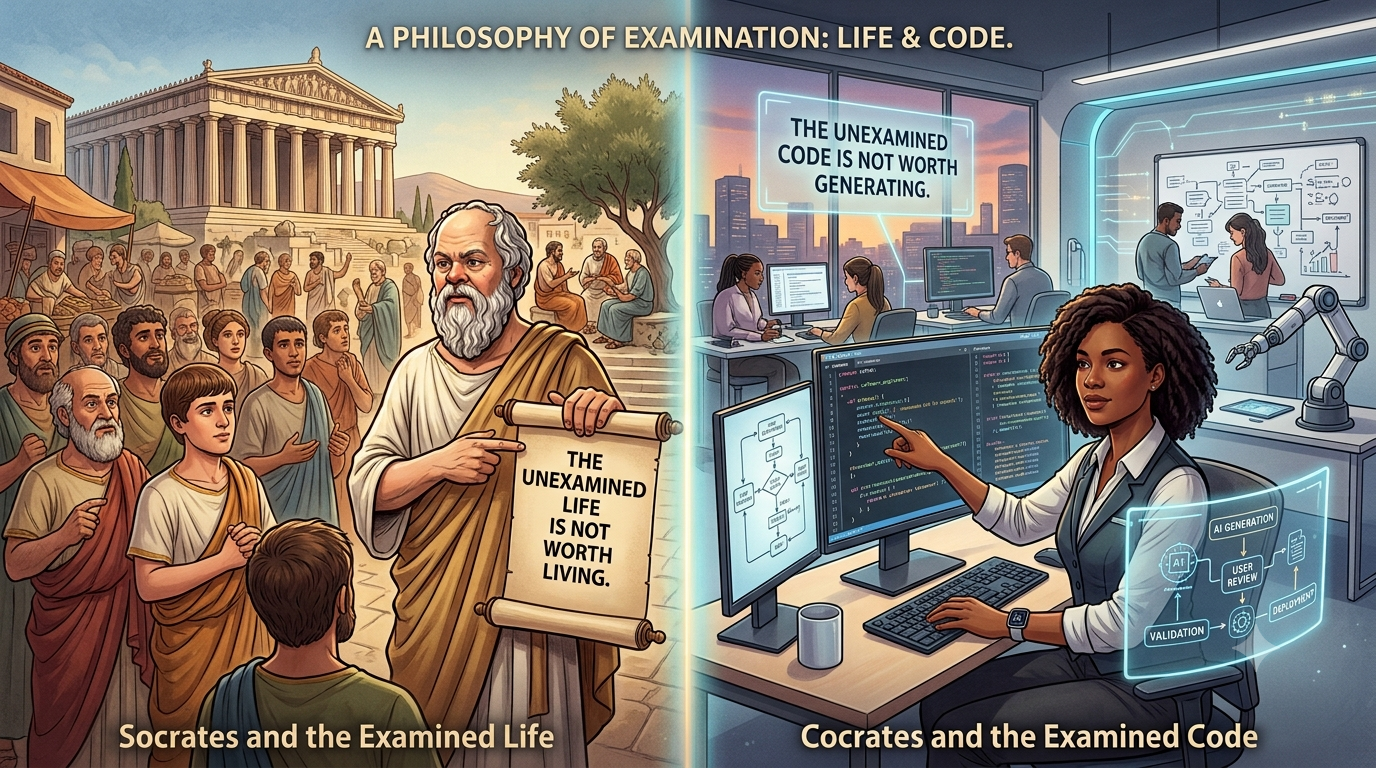
Socrates said: "The unexamined life is not worth living." "A life without reflection isn't worth living."
Question constantly, admit your ignorance, move toward truth—that was Socrates on how to live well.
Cocrates brings that philosophy into development.
"The unexamined code is not worth generating." "AI output I don't understand and haven't reviewed has no value."
This isn't wordplay. Where Socrates questioned how to live, Cocrates questions how engineers should act in the AI era.
"Are you using unreviewed output right now without thinking?"
💻 The Expanded Meaning of 'Code' — Your Deliverables Are Code Too
One thing to clarify:
"Wait—I'm not a developer... Code? What code am I supposed to review?"
No. Code in Cocrates means something much broader.
- 💻 Source code — obviously included.
- 📝 Reports and documents — business reports, plans, proposals written by AI
- 📊 Presentations and slides — decks AI built for you
- 📚 Blog series — this article is Code too
- 🧠 Study notes and summaries — anything you asked AI to summarize
Everything you asked AI to "make for you." That's what Cocrates calls Code.
🏗️ Architecture Matters — No "Just Build It"
So how do you actually do this?
To understand Cocrates' approach, look at this blog series itself—it's being built the Cocrates way.
Step 1. Design the big picture. Structure the whole series in overview.md, then review and approve.
Step 2. Build each episode's skeleton. Outline per episode in outline.md, then review and approve again.
Step 3. Detail the design. Flesh out each episode in episodes.md, then review and approve again.
Step 4. Generate the body, then final review and approval.
See it? Review (🔍) and approval (✅) at every step. Cocrates never allows "Let's just build something and see."
"One hour reviewing structure saves a week of bug fixes."
That's the Cocrates way.
🔬 What Review Really Is — U → A → E → A
Honestly—what do most people think "review" means? "Skim it and check for typos?" Right?
Cocrates says: that's not review.
Real review has four stages.
First, U — Understand
You understand when you can explain it in your own words. Why AI built it this way, how the structure fits together—the "Oh, so that's why it's shaped like this" moment.
Second, A — Analyze
"Why was it implemented this way?" What's the design intent? Was there a better approach? Look at structure, not just the surface.
Third, E — Evaluate
"Is this really the best option?" Judge against project goals and your standards.
Fourth, A — Approve
"I've checked. We're going with this. I'm accountable." Review is only complete when you can say that.
U → A → E → A.
That's Cocrates' definition of review.
🎯 Harnessing Ignorance
One more question follows:
"Why review so hard? Am I just hunting typos?"
No. The ultimate purpose of review is something else.
Harnessing Ignorance.
While reviewing, you inevitably hit moments like:
- "Wait—why is this part like this?"
- "Was I wrong about this?"
- "Oh—there's an approach like that too."
That moment is when ignorance is removed.
Learning what you didn't know. Questioning what you took for granted. That's the real purpose of review.
Cocrates' principle is simple:
"Never leave ignorance unattended."
If you don't know, ask. If you don't understand, probe. Review isn't just fixing errors—it's your growth process.
🛡️ Cocrates — Guardrails That Protect Your Agency
By now you might think:
"You want me to review and approve every time? Isn't that exhausting?"
Yes. At first, it is.
👤 You say: "Too much hassle—just make a login module, roughly."
🦉 Cocrates replies: "Unexamined output isn't worth generating. Shall we design the structure together first?"
At first it can sound like nagging. "Just build it—why so strict?"
But think about it.
"One hour reviewing structure prevents a week-long bug."
Cocrates isn't a vending machine for answers. It's guardrails that protect your agency. It doesn't slow you down—it checks you're heading the right way.
📌 Key Takeaways
-
Principle declared. "Unexamined output isn't worth generating." — the first principle of the AI-native engineer.
-
Expanded Code. Code isn't only source. Everything AI makes—reports, slides, blogs, study notes. All of it is Code.
-
Four stages of review. U → A → E → A. Understand, analyze, evaluate, approve—not typo checking.
-
Harnessing ignorance. The ultimate purpose of review is discovering what you don't know and filling those gaps as you grow.
One mission:
Pause this article. Recall the most recent thing you got from AI. Run it through U → A → E → A.
- Do you understand it? (Understand)
- Why is it this way? (Analyze)
- Is it really the best? (Evaluate)
- Can you approve it? (Approve)
Try that, then continue.
🎬 Coming Up Next
Today we learned what the right thing is. We declared the principle, defined review, and learned that removing ignorance is review's ultimate purpose.
But knowing a principle and living it are different things.
Next, Ep3: how to practice. Installing Cocrates Harness. Simpler than you think—a few lines of config and this principle applies automatically to your AI workflow.
The real journey starts after install. We'll take that first step together next time.
This series introduces the Cocrates Harness framework. Cocrates is an agent harness designed for Socratic dialogue so users keep agency and grow.