EP14. Cocrates Harness User Manifesto
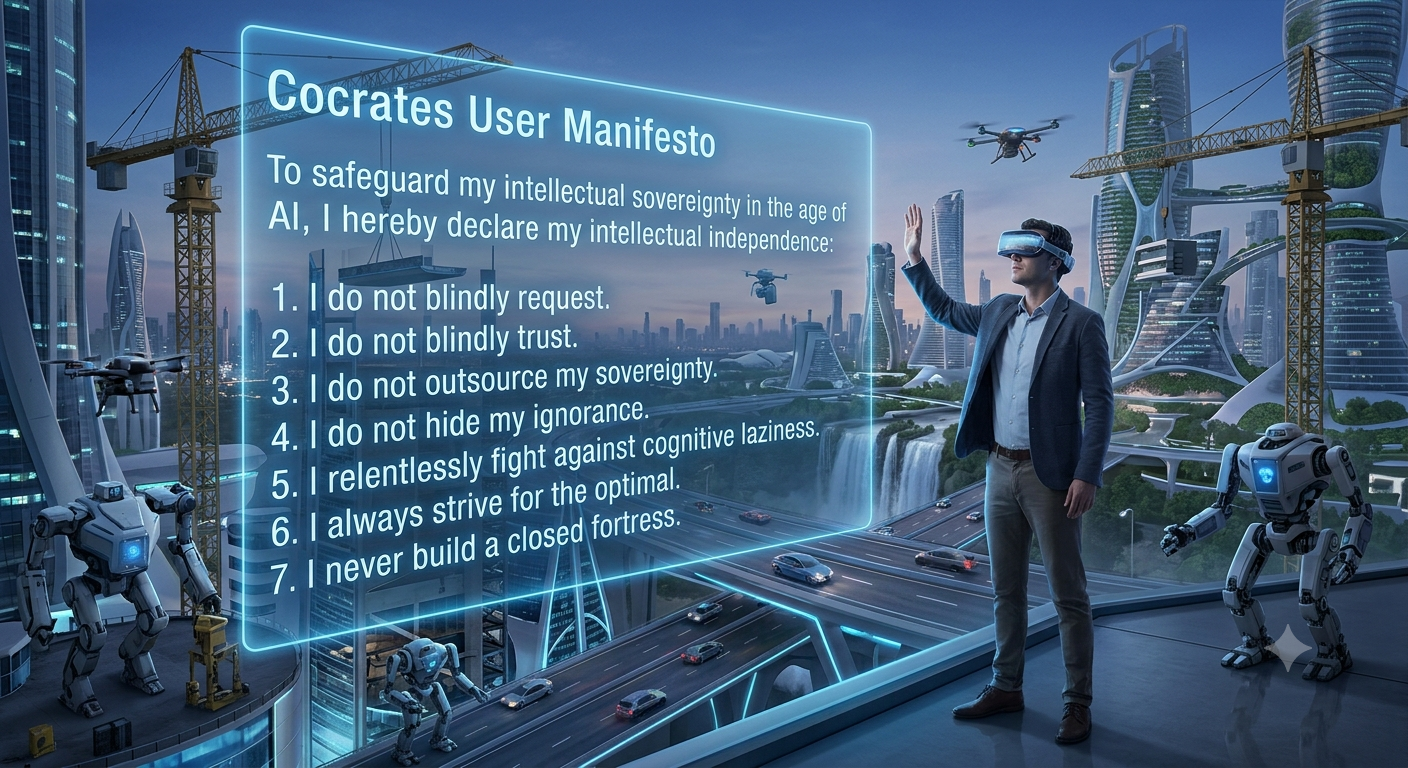
This is a manifesto.
Through thirteen episodes we traveled together—from Ep1's "How many AI teammates do you have?" to Ep13's "mutual evolution of user and framework."
That journey had one aim:
For you to become an AI-native engineer.
Today, at the end of that journey, we condense the teachings of thirteen episodes into seven commandments. This is not a mere summary. This is a declaration—your commitment as an engineer living in the AI age.
🏛️ Three Philosophies — Foundation of the User Manifesto
Before declaring the seven commandments, we first declare the three philosophies that underpin them.
Philosophy 1. "The unexamined code is not worth generating."
This principle, declared in Ep2, was the beginning of everything. Unreviewed output is not worth generating. No matter how excellent AI's result may be, if you have not understood and reviewed it, it has no value. Without this principle, the AI-native engineer cannot exist.
Philosophy 2. "I know I know nothing."
These are Socrates' words. "Knowing that I know nothing is the beginning of wisdom." In the AI age, this saying grows even more powerful. AI holds vast knowledge—but real learning begins when you admit what you do not know. Do not be ashamed of ignorance; question what you do not know. That is the first step of growth.
Philosophy 3. "Harness Ignorance."
Do not fear ignorance—harness it. When you discover what you do not know, you have two choices: ignore it, or learn it. Cocrates helps you choose the latter. Ignorance is not an obstacle—it is the engine of growth.
📜 User Manifesto — Seven Commandments
I now declare that as an AI-native engineer, I will keep the following seven commandments.
Commandment 1. I reject requests without design.
"I do not blindly request."
Before shouting "build this for me" at AI, I must first construct purpose and architecture in my own mind. Requests must follow thoroughly aligned architectural requirements (ASR). Questions poured out without clearly defined design and constraints are nothing but the product of cognitive laziness.
Think first, architecture next, finish review—only then command the system to build. Only then, after the output exists, can you as a human architect explain perfectly why it must exist as it does.
Commandment 2. I reject trust without verification.
"I do not blindly trust."
Recognize that every text, code, and architecture AI generates is not a perfect answer but a "lump of the most plausible potential errors." The moment you look at AI's output and move on thinking "it probably got it right," you forfeit your standing as an architect.
Trust is suspended until you personally verify accuracy, consistency, and structural fitness through the harness's rigorous gateway. In the Cocrates worldview, true trust is the spoils won at the end of thorough verification and review.
Commandment 3. I do not surrender the sovereignty of context.
"I do not outsource my sovereignty."
This is the resolve not to hand over the direction of conversation, business priorities, and the hilt of architectural decisions to AI in exchange for the sweetness of convenience. Do not entrust your project's fate to the "easy shortcuts" or biased "defaults" that LLMs propose.
AI is only an agent and assistant operating within harsh specifications; the absolute sovereignty to control context and make final decisions belongs solely to the human architect. The moment you outsource sovereignty, you descend from master of the system to slave of AI.
Commandment 4. I do not pretend to know what I do not.
"I do not hide my ignorance."
Great architecture and growth begin when you face and admit what you do not know. Saying "I don't know" is not shameful. The most shameful thing is pretending to know, moving on, and being buried under AI's slapdash generation.
Do not avoid the piercing questions and constraint warnings the Cocrates system throws at you. Only when you precisely map the gaps in your cognition and fill those blanks with explicit knowledge does true intellectual independence come to completion.
Commandment 5. I fight cognitive laziness to the end.
"I relentlessly fight against cognitive laziness."
This is the combative decision not to let the gravity of AI's "quick answers" pull you into atrophying the mental muscle of thinking and deliberation. Do not compromise with the poisonous convenience of copying and running at random.
When the system seems ready to spew output at full throttle, stop the gears and engage meta-cognition. Constantly press your brain: "Do I truly understand this architecture perfectly right now?" The instant you resist convenience's temptation and dare to reflect—that is the moment human intelligence breaks through its threshold.
Commandment 6. I always strive for the optimal architecture.
"I always strive for the optimal."
This is the designer's persistence to push limits and find the optimal architecture—not settling for AI's first output or a single right answer. There is no compromise of "good enough" in architecture.
Force derivation of diverse alternative matrices (ADR) and contrast the trade-offs (pros/cons) until your bones ache. Only decisions forged by pushing limits through prisms of cost, scalability, maintainability, and more earn the right to settle as the system's constitution (Spec).
Commandment 7. I never build my own closed fortress.
"I never build a closed fortress."
The moment you lock yourself inside the fortress of illusion that your design and skills are perfect, the evolution of intelligence stops and becomes stagnant water. Listen fearlessly to fellow architects' sharp criticism and opposing views. If a better architecture is proven, refactor your system flexibly at any time.
When you share your know-how with the world and continuously compile collective intelligence into your system's skills, our architecture ecosystem becomes an immortal gene that never perishes.
🦉 Cocrates Harness + User Manifesto = AI-native Engineer
Does declaring the seven commandments end here? No.
Tool and will must go together.
Cocrates Harness is the tool—a framework that enables architecture-driven generation, enforces review and approval procedures, and supports every stage from learning to creation.
User Manifesto is will—the personal commitment not to request without design, not to trust without verification, to keep sovereignty over context, not to pretend ignorance away, to fight cognitive laziness, to strive for the optimal, and to reject closed fortresses.
Cocrates Harness + User Manifesto = AI-native engineer.
No matter how excellent the tool, it means nothing without will. No matter how strong the will, practice is hard without a tool. When these two meet, a true AI-native engineer is born.
And an AI-native engineer can expand capability without limit. You can grow infinitely—from one engineer to three, to ten—leading AI teammates according to your capability.
🔄 Circular Return — The End Is the Beginning
Every journey has an end. And the end is a beginning again.
In Ep1 we threw the series' first line:
"How many AI teammates do you have?"
And in Ep14, the final episode, we return to the first principle:
"The unexamined code is not worth generating." "Output that hasn't been reviewed isn't worth creating."
This one line was the start of this series—and its end.
Whether you use Cocrates from today, use another tool, or use no tool at all, this principle and the seven commandments do not change. Because this is not a declaration about a tool—it is a declaration about how to live as an engineer in the AI age.
📌 Key Takeaways — The Whole Series
- Three philosophies. "The unexamined code is not worth generating"—the principle of review and approval. "I know I know nothing"—humility and the stance of learning. "Harness Ignorance"—harness ignorance as fuel for growth.
- User Manifesto — seven commandments. No requests without design, no trust without verification, no outsourcing sovereignty, no pretending ignorance away, fighting cognitive laziness, striving for optimal architecture, rejecting closed fortresses.
- Cocrates Harness + User Manifesto = AI-native engineer. The union of tool and will enables unlimited capability expansion.
- Circular return. The end is the beginning again. The first principle is the last principle.
Final question.
This series began with one question:
"How many AI teammates do you have?"
Now, for the last time, ask yourself this question.
And you should be able to answer:
"It depends on my capability. I am growing even now. Tomorrow I will be able to lead more teammates than today."
This series introduces the Cocrates Harness framework. Cocrates is an agent harness designed for Socratic dialogue so users keep agency and grow.