EP6. Architecture-Driven Skill Creation in Practice
In Ep5 we saw what happens when you ask Cocrates to "build jsondb"—ADR and Spec before architecture-driven generation. We learned not to trust AI blindly and to design with review.
Today we go one step further. Ep5 was "how to have AI make code." Ep6 is "how to teach AI how to work."
The subtitle says it: teach AI "how to write reports." Beyond one-off requests—design AI's behavior itself.
🎣 "Write a Report" vs "How to Write Reports"
Compare two approaches.
Typical: "Write a report"
Every request yields different quality. Fine today, bad tomorrow—structure varies even on the same topic. Repetition fatigue. That's the limit of one-off requests.
Cocrates: "Create a skill for writing reports"
Build once, reuse forever. Same request type → same workflow → consistent quality.
Like asking "catch me a fish" every time vs teaching "how to fish."
A skill is AI's behavioral standard—a repeatable workflow. Rules so AI handles the same request type consistently.
Today we build document-authoring—a workflow for reports and explanatory documents.
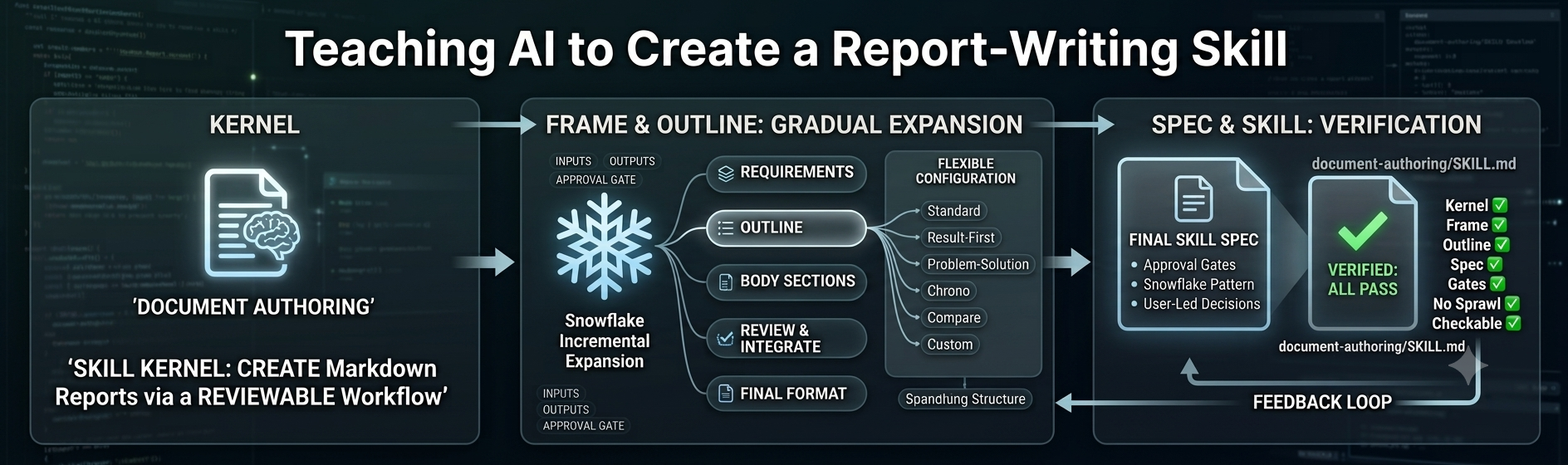
🎯 Kernel — One Sentence for Core Purpose
Every skill starts with a Kernel—one sentence defining what the skill does.
Cocrates asked three questions:
- "What does this skill generate?"
- "Who uses it?"
- "What form does the output take?"
From the answers came the Kernel:
"This skill helps generate Markdown explanations or reports through reviewable stages in typical situations."
One sentence defines the skill. The Kernel guides everything after.
🏗️ Frame — Building the Skeleton
With Kernel defined, Frame designs document hierarchy and generation stages.
Document hierarchy:
Meta → Outline → Body → Conclusion → Appendix
Generation stages (P1–P5):
P1: Requirements analysis → P2: Outline → P3: Section content → P4: Integration & review → P5: Final formatting
Each stage has clear inputs, outputs, and approval conditions.
🎯 Outline — The Dramatic Moment
The most important thing happened in Outline.
Cocrates proposed "Introduction → Body → Conclusion"—typical and safe.
The user pushed back:
"It's not always intro → body → conclusion. Some reports don't need an intro; leading with the conclusion can work better."
That broke AI's Silent Default. Cocrates designed six customizable document structures:
- Standard: Introduction → Body → Conclusion
- Conclusion-first: Conclusion → Body → Summary
- Problem-solution: Problem → Cause → Solution
- Chronological: Background → Development → Result
- Comparative: Topic A → Topic B → Synthesis
- Freeform: User defines structure
💡 Lesson: AI's first proposal isn't always right. AI offers the most common pattern. Your context and insight build better structure. "It's not always intro→body→conclusion" broke a fixed idea and evolved a more flexible architecture.
📋 Spec — Completing the Design
After Outline was fixed, Cocrates merged decisions into a Spec.
Five core principles:
- Stage approval gates—user review at each step
- Snowflake gradual expansion—start small, refine incrementally
- Self-containment—Spec alone must be enough to generate
- Verifiability—each item pass/fail
- User-led—user makes final calls, not AI
Six document structures: as above
Seven prohibitions:
- No verbose prose
- No advancing stages without user confirmation
- No content outside the Spec
- ...
Five completion criteria:
- User approval on all stages
- Each section matches Spec
- ...
📄 Skill Creation — And Verification
After the Spec, Cocrates created .opencode/skills/document-authoring/SKILL.md.
It verified the skill with 7 checklist items.
Result: all PASS ✅
| Check | Result |
|---|---|
| Kernel clearly defined? | ✅ |
| Frame designed? | ✅ |
| Outline detailed? | ✅ |
| Spec self-contained? | ✅ |
| Approval gates at each stage? | ✅ |
| Prohibitions clear? | ✅ |
| Completion criteria verifiable? | ✅ |
🔄 After the Skill — What Changes
Once the skill exists, the experience changes completely.
Before: "Write a report" → AI generates wildly → user passively accepts
After: "Write a project retrospective" → document-authoring activates → P1 through stages with user collaboration → review and approve each step → consistent quality
You're no longer waiting passively for AI output. You become an active designer who shapes and controls the process.
❄️ Shared Snowflake Pattern
Ep4 (learning), Ep5 (generation), Ep6 (skill creation)—all share the Snowflake pattern.
| Stage | Ep4 (Learning) | Ep5 (Generation) | Ep6 (Skill) |
|---|---|---|---|
| Start small | Concept briefing | Clarify requirements | Define Kernel |
| Expand gradually | 3 missions | 3 ADRs | Frame→Outline→Spec |
| Review & approve | After each mission | Each ADR approved | Each stage approved |
| Save to file | kb/bloom-taxonomy.md | spec/jsondb.md | skills/document-authoring/SKILL.md |
This pattern applies consistently across Cocrates activities.
📌 Key Takeaways
- Skills design how AI works. Beyond one-offs—define AI behavior. Build once, reuse as lasting asset.
- Don't accept AI proposals without review. AI tends toward easy, generic choices. Use U→A→E→A for better fits.
- Snowflake is the shared pattern. Start small, expand, review and approve—learning, generation, skills.
- With a skill, you become an active designer. No more passively waiting—you design and control.
Ask yourself:
- Can you explain one-off requests vs skills?
- Can you name the six stages of skill creation?
- How does Snowflake apply in Ep4, Ep5, and Ep6?
🎬 Coming Up Next
Three practice episodes covered Cocrates' core activities.
Ep4: Learning — Education, Knowledge Capture, Reflection. Ep5: Generation — ADR, Spec, Generation, Verification. Ep6: Skill creation — Kernel, Frame, Outline, Spec, Skill, Verification.
You've experienced all three.
Next, Ep7: Cocrates framework structure and principles—architecture deep dive.
You've learned to use Cocrates; Ep7 opens the hood—Agent and Skills, harness design, Intent-To-Skill Routing.
"Will you ask AI for a fish—or teach it how to fish?"
Whatever you choose, Cocrates walks with you.
This series introduces the Cocrates Harness framework. Cocrates is an agent harness designed for Socratic dialogue so users keep agency and grow.