EP12. Architecture-Driven Skill Creation Principles
So far we've learned two Cocrates generation modes.
First: If a dedicated skill exists for A, use it. "Generate a blog series" → blog-series-authoring. Fast and simple.
Second: If not, fallback to spec-driven-generation. ASR → ADR → Spec → Generation → Verification.
But after Ep11, you might wonder:
"What if the skill I need doesn't exist at all?"
Say you need "generate a regular code review report." No such skill. You could fallback every time—or build the skill once if you'll repeat the pattern.
Today: generating-skill-creation—the skill for making skills.
🔍 Meta-Skill: A Skill for Making Skills
generating-skill-creation is Cocrates' meta-skill. Unlike normal skills that produce artifacts, it designs and creates skills themselves.
Compare by analogy:
- Normal skill: "Catch me a fish" → fishing technique
- Meta-skill: "Teach me to fish" → teaching fishing
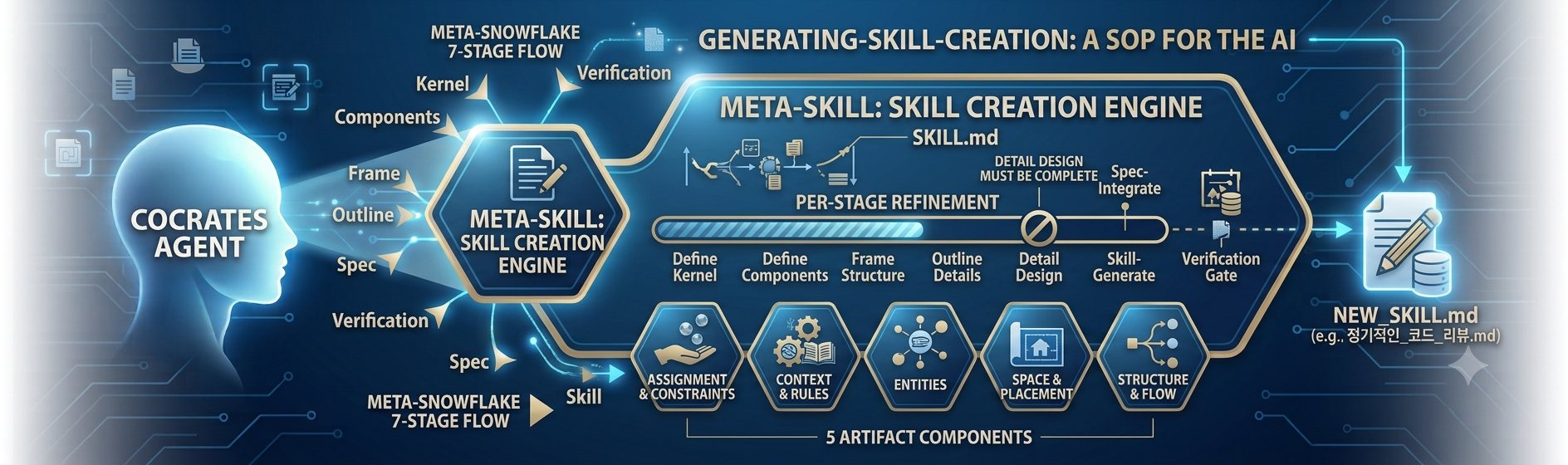
generating-skill-creation runs on five Artifact Components:
Five Artifact Components:
- Assignment & Constraints: What problem and constraints does this skill solve?
- Context & Rules: What context and rules govern the skill?
- Entities: What concepts and objects does the skill handle?
- Space & Placement: Where do outputs live and how are they arranged?
- Structure & Flow: What are the stage-by-stage flow and structure?
Defining these five is the first step in skill creation.
❄️ Snowflake Five Stages — Gradual Concretion
Once Components are identified, Cocrates refines the skill through Snowflake five stages:
Stage 1 — Define: "What does this skill do?" Define Kernel in one sentence.
Stage 2 — Plan: "In what order?" Plan overall stages and sequence.
Stage 3 — Architecture Design: "How do components relate?" Design Entities, Space, Flow.
Stage 4 — Detail Design: "What exactly happens each stage?" Inputs, outputs, approval conditions, prohibitions.
Stage 5 — Generation: "Generate SKILL.md." Only after all design is complete.
One critical rule:
🚫 Absolute Rule — No Generation Before Detail Design Is Complete
Among Cocrates' generation principles, this is enforced most strictly:
"Do not move to Generation until Detail Design is fully settled."
Why? Ep2's principle: "The unexamined code is not worth generating." A skill permanently defines AI behavior. A bad skill repeatedly produces bad results.
So in Detail Design, Cocrates rigorously checks:
- Are inputs and outputs clear per stage?
- Approval gates at every stage?
- Are prohibitions concrete?
- How are exceptions handled?
Not one line of SKILL.md until every question is answered.
🔄 Meta Snowflake Seven Stages — The Bigger Picture
Snowflake five stages are the basic skill design process. generating-skill-creation paints a bigger picture: Meta Snowflake seven stages.
Kernel → Components → Frame → Outline → Spec → Skill → Verification
In order:
Kernel: One sentence defining skill purpose.
Components: Identify and define the five Artifact Components.
Frame: Overall structure and skeleton—which stages exist.
Outline: Detail Frame—sub-items and flow per stage.
Spec: Self-contained spec integrating all decisions. Anyone reading only Spec understands the full behavior.
Skill: Generate SKILL.md from Spec.
Verification: Does the skill match Spec? Anything missing?
Not pure sequence or parallel—each stage depends on the prior; verification feedback can return to earlier stages.
🎯 Per-Stage Refinement — Lazy Refinement Strategy
One important principle in Meta Snowflake seven stages:
Components don't concretize at the same rate.
Some are very specific early; some clarify only at the end. Cocrates calls this Lazy Refinement.
Example: Entities get rough shape in Kernel/Components, detail in Outline/Spec. Structure & Flow need detail from Frame onward.
Why? Avoid premature decisions. Early lock-in makes later better options hard to adopt. Lazy refinement delays decisions to keep flexibility.
💡 Today's Insight: Skills Are AI SOPs
A skill is giving AI an SOP (Standard Operating Procedure).
When a new hire joins, you teach workflow: "When this request comes, check A, review B, then do C."
Skills do that for AI: "For this request type, work this way."
Once defined, a skill is reusable asset—today, next week, a year from now, same quality.
One-off requests are consumables. Skills are assets.
📌 Key Takeaways
- generating-skill-creation is a meta-skill based on five Artifact Components.
- Snowflake five stages: Define → Plan → Architecture Design → Detail Design → Generation—with approval gates between stages.
- Absolute rule: no Generation before Detail Design is complete. Bad skills multiply bad output.
- Meta Snowflake seven stages: Kernel → Components → Frame → Outline → Spec → Skill → Verification.
- Lazy refinement: don't concretize everything at once—only when needed.
Ask yourself:
- Can you explain Snowflake five vs Meta Snowflake seven?
- Can you name and explain the five Artifact Components?
- Why is Lazy Refinement important?
🎬 Coming Up Next
We've covered all of Cocrates.
Ep1–2 philosophy and principles, Ep3 install, Ep4–6 practice, Ep7–10 internals, Ep11–12 core and meta-skills.
We're ready to use Cocrates.
But an important question remains:
"Is that the end? Is 'using Cocrates well' enough?"
No. The real part starts now. Using Cocrates isn't enough.
Ep13: Users must evolve; Cocrates Harness must evolve too—and the two form a reinforcing feedback loop.
"Using Cocrates isn't enough—you must evolve Cocrates."
This series introduces the Cocrates Harness framework. Cocrates is an agent harness designed for Socratic dialogue so users keep agency and grow.